15 Common Things That Are 59 Inches Long (Everyday Examples)
59 inches is exactly 4 feet 11 inches, or 149.86 centimeters. That is just one inch shorter than 5 feet, making it easy to visualize as a length of almost 5 feet. Everyday examples include a small loveseat, a 59-inch desk, a five-foot measuring tape extended nearly to its end, and certain kitchen islands, tables, and garden tools.
Knowing what 59 inches looks like can help you compare furniture, measure available space, choose equipment, and understand product dimensions. Below are 15 practical examples, exact conversions, and useful measurement tips. For more helpful size comparisons and everyday measurement guides, visit Snap Planets.
Key Takeaways
- 59 inches equals 4 feet 11 inches, which is exactly one inch less than 5 feet.
- In metric units, 59 inches is 149.86 centimeters, 1.4986 meters, or 1,498.6 millimeters.
- Household examples include some compact loveseats, console tables, desks, kitchen islands, and shelving units.
- Many everyday products vary in size, so an object described as approximately 59 inches is not necessarily an exact match.
- For accurate planning, check whether the stated dimension refers to an item’s length, width, height, or diagonal measurement.
How Long Is 59 Inches? Exact Measurements and Visual Comparisons
A distance of 59 inches is almost 5 feet long. Imagine a standard 60-inch measuring tape extended to the 59-inch mark, or a five-foot-tall vertical space with just one inch removed. Both provide a straightforward picture of this measurement.
Because one foot contains 12 inches, dividing 59 by 12 gives 4 complete feet with 11 inches remaining. That makes the exact feet-and-inches conversion 4 feet 11 inches.
59 Inches Conversion Table
| Measurement Unit | Equivalent of 59 Inches |
|---|---|
| Inches | 59 in |
| Feet and inches | 4 ft 11 in |
| Decimal feet | 4.9167 ft (approximately) |
| Centimeters | 149.86 cm |
| Meters | 1.4986 m |
| Millimeters | 1,498.6 mm |
| Yards | 1.6389 yd (approximately) |
The metric conversions are based on the exact relationship of 1 inch to 2.54 centimeters. Therefore, multiplying 59 by 2.54 gives precisely 149.86 centimeters.
How Does 59 Inches Compare With Other Lengths?
- Compared with 4 feet: 59 inches is 11 inches longer than 48 inches.
- Compared with 5 feet: 59 inches is one inch shorter than 60 inches.
- Compared with 1.5 meters: 59 inches is 0.14 centimeter shorter than 150 centimeters.
- Compared with 6 feet: 59 inches is 13 inches shorter than 72 inches.
These comparisons are useful because people often recognize whole-foot or round metric measurements more easily than an unfamiliar number of inches.
When shopping, you may also encounter products advertised as 150 centimeters long. That is approximately 59.06 inches, making a 150-centimeter item a particularly close visual comparison.
15 Everyday Things That Are About 59 Inches Long
Objects measuring approximately 59 inches appear in furniture, household storage, clothing, recreational equipment, and home improvement projects. Some are manufactured in exact 59-inch or 150-centimeter sizes, while others can be found in models close to that measurement.
The examples below distinguish between fixed measurements and product dimensions that vary by manufacturer. For furniture and equipment, always verify the exact size of the item you intend to buy.
1. A Compact Two-Seater Loveseat
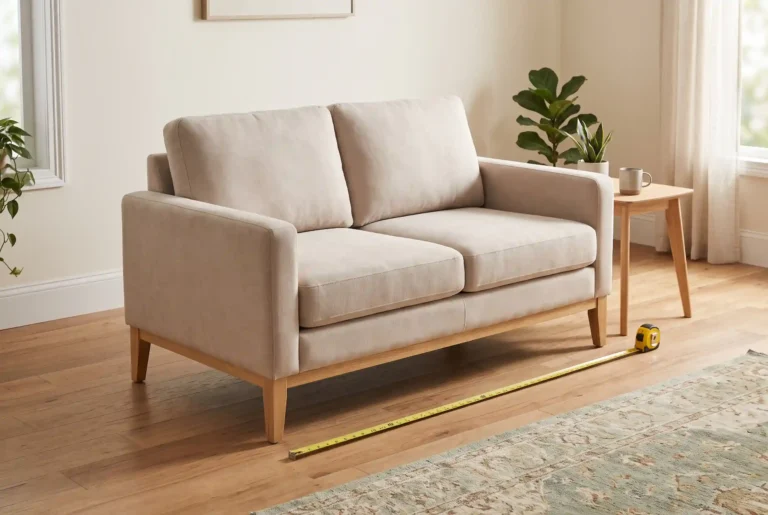
A compact loveseat is one of the easiest ways to picture a width of approximately 59 inches. Certain small two-seat sofas have an overall width around 59 to 60 inches, although larger loveseats can be considerably wider.
Unlike a full-size couch, a compact loveseat is designed to seat two people while occupying less floor space. It can work well in studio apartments, bedrooms, offices, and smaller living rooms.
When measuring a loveseat, the advertised width typically includes the arms, not just the seating cushions. A 59-inch-wide loveseat may therefore provide considerably less than 59 inches of usable sitting space.
Practical comparison: A 59-inch loveseat is almost exactly 5 feet wide, making it a helpful reference for visualizing a short wall or furniture arrangement.
2. A 150-Centimeter Office Desk
Some office desks and computer tables are manufactured with desktops measuring 150 centimeters wide. That converts to approximately 59.06 inches, which is extremely close to 59 inches.
A desktop of this width can accommodate a monitor, keyboard, mouse, and additional working materials. Depending on monitor size and mounting arrangements, it may also accommodate two displays.
However, desktop width alone does not determine whether a workstation will be comfortable. Depth, available legroom, equipment placement, and surrounding clearance also matter.
Practical comparison: A 150-centimeter desk offers an almost exact metric reference for a 59-inch horizontal distance.
3. A Small Entryway Console Table
Console tables are often used behind sofas or along entryway walls. Some larger console tables are approximately 59 inches long, providing a useful surface for lamps, decorative objects, and storage accessories.
These tables are usually much shallower than dining tables, so their length does not necessarily indicate that they occupy a large amount of floor space.
If you want to place a console table in a hallway, measure both the table’s depth and the remaining passage width. A suitable length does not guarantee that the furniture will fit comfortably.
Practical comparison: Imagine a narrow furniture surface extending nearly 5 feet along a wall.
4. A 150-Centimeter Kitchen Island
Freestanding kitchen islands and preparation tables are sometimes available in lengths around 150 centimeters, or roughly 59 inches.
This size can provide a substantial additional preparation surface without requiring the length of a large permanent island. Depending on its construction, an island may also include shelves, drawers, or room for seating.
For seating, the amount of usable space depends on the overhang, support legs, and stool width. Do not assume that every 59-inch island accommodates the same number of people.
Before choosing an island, measure the remaining clearance around cabinet doors, appliances, and walkways. The right island must fit the entire kitchen layout, not just the available wall or floor length.
Practical comparison: A five-foot counter surface with one inch removed closely represents a 59-inch island.
5. A Compact Refrigerator Approximately 59 Inches Tall
Some apartment-sized and relatively compact refrigerators stand approximately 59 inches tall. Refrigerator heights vary considerably by type and manufacturer, so this is a possible model dimension rather than a universal standard.
A refrigerator of this height reaches just below 5 feet and can be noticeably shorter than many full-size kitchen refrigerators.
When measuring an appliance, distinguish the cabinet height from the overall height, which may include hinges or other protruding components.
Manufacturers may also require ventilation space around the appliance. Always follow the installation dimensions specified for the particular model.
Practical comparison: A 59-inch-tall refrigerator offers an upright reference for a length just under 5 feet.
6. A Five-Foot Folding Table With a Slightly Shorter Top
Many folding utility tables are sold in nominal five-foot lengths, or 60 inches. A folding table with an actual top length of 59 inches would be only one inch shorter than that familiar size.
Some tables manufactured to metric dimensions are close to 150 centimeters, while others use different standard lengths. The size should be checked rather than assumed from the category name.
A tabletop near 59 inches can be useful for temporary workstations, craft projects, serving food, or organizing supplies.
Practical comparison: Picture a five-foot folding table with a small one-inch section removed from the end.
7. A Large Storage Bench
Some long storage benches measure approximately 59 inches across. These may be placed at the end of a bed, beneath a window, or along an entryway wall.
The combination of seating and enclosed storage makes this furniture type useful in rooms where floor space is limited.
Actual dimensions vary depending on the upholstery, frame, and whether the bench has arms. Seating capacity and weight limits should be determined from the manufacturer’s specifications.
Practical comparison: A 59-inch storage bench spans nearly the same distance as a five-foot line marked on the floor.
8. A 150-Centimeter Bookshelf
Bookshelves and display units with a height or width of 150 centimeters provide another close reference. At approximately 59.06 inches, this metric dimension differs from 59 inches by less than one-tenth of an inch.
A shelf of this height is just under 5 feet tall. A shelf of this width occupies almost 5 feet of wall space, so the direction of the measurement is important.
Bookshelves must be selected according to their stability, supported loads, and any manufacturer-required anchoring instructions.
Practical comparison: A 150-centimeter shelving unit gives you an almost exact representation of 59 inches in either a vertical or horizontal orientation.
9. A Long-Handled Garden Hoe
Long-handled garden hoes are available with handles in the neighborhood of 54 to 60 inches, depending on their design. A 59-inch handle falls near the upper end of that example range.
The handle enables a gardener to work standing up rather than remaining close to the ground. The appropriate size depends on the user’s height, grip, and intended gardening task.
Remember that the handle length is not necessarily the same as the total tool length. The hoe head and its angle can affect the overall measurement.
Practical comparison: A garden tool handle extending almost 5 feet provides a simple outdoor example of the measurement.
10. An Adult Hockey Stick
Certain adult hockey sticks have shaft lengths near 59 inches, although hockey stick measurements can be confusing because manufacturers may use different measuring conventions.
Some specifications describe the distance from the heel of the blade to the top of the shaft. Others describe shaft length or overall stick length using a different reference point.
A hockey stick’s ideal length also depends on player height, skating posture, and preference.
Practical comparison: A stick specified as 59 inches along its stated measurement line provides a near-five-foot reference, but always check how that length was measured.
11. A Five-Foot Wooden Dowel Cut to 59 Inches
Wooden dowels are used in woodworking, crafts, furniture repairs, and home improvement projects. A five-foot dowel begins at 60 inches and can be cut to exactly 59 inches by removing one inch.
Unlike examples based on manufactured furniture dimensions, this is an object you can easily prepare to an exact length.
A straight dowel also makes a convenient physical measuring reference when a flexible tape measure is difficult to hold in position.
Practical comparison: This is an exact 59-inch example when the dowel is measured and cut correctly.
12. A 150-Centimeter Curtain Rod
Adjustable curtain rods can accommodate a range of window widths, and certain models can be set close to 59 inches. Metric rods adjusted to 150 centimeters are particularly close.
The measurement usually refers to the rod’s adjusted span, although decorative finials can extend beyond the main rod.
When fitting curtains, account for the mounting bracket positions and the amount of space beyond the window frame. The intended curtain coverage may be wider than the window opening itself.
Practical comparison: A curtain rod adjusted to approximately 150 centimeters forms a nearly 59-inch horizontal line above a window.
13. A Petite Floor-Length Formal Dress
Some floor-length dresses can measure approximately 59 inches from the shoulder to the hem. However, dress length depends heavily on the garment design, intended wearer height, and where the measurement begins.
There is no single 59-inch length that applies to all petite formal dresses. A measurement from the shoulder is different from one taken from the waist or neckline.
When ordering a gown online, compare the published measurement with your body measurements and intended footwear.
Practical comparison: A dress with a specified shoulder-to-hem measurement of 59 inches can help illustrate this vertical distance when hung straight.
14. A 150-Centimeter Decorative Wall Shelf
Long floating shelves and wall-mounted display shelves can be made in 150-centimeter lengths, approximately 59 inches.
This type of shelf may be used to display photographs, books, plants, and small decorative items. It provides almost 5 feet of uninterrupted horizontal surface.
For installation, shelf length is only one consideration. Wall construction, mounting hardware, shelf material, and intended load also affect safety and suitability.
Practical comparison: A long wall shelf measuring 150 centimeters gives a direct visual example of a nearly 59-inch span.
15. An Exactly Measured 59-Inch Piece of Rope
A piece of rope cut to 59 inches is one of the simplest exact references you can create at home. Unlike a piece of furniture, there is no need to find a particular product model.
Lay the rope straight beside a tape measure, mark the 59-inch point, and cut it accurately. Avoid stretching the rope during measurement, especially if it is made from an elastic material.
You can then place it along a wall, countertop, or floor to visualize the available space.
Practical comparison: A correctly measured rope provides an exact physical representation of 4 feet 11 inches.
Quick Comparison of All 15 Examples
The following table summarizes which examples are close metric equivalents, which are variable manufactured products, and which can be made to measure exactly 59 inches.
| Everyday Object | Relevant Dimension | How Closely It Matches 59 Inches |
|---|---|---|
| Compact loveseat | Overall width | Some models are around 59 inches |
| Office desk | Desktop width | 150 cm is about 59.06 inches |
| Console table | Overall length | Model-dependent |
| Kitchen island | Overall length | 150 cm is about 59.06 inches |
| Compact refrigerator | Overall height | Some models are near 59 inches |
| Folding utility table | Tabletop length | Near nominal 60-inch models |
| Storage bench | Overall width | Model-dependent |
| Bookshelf | Height or width | 150 cm is about 59.06 inches |
| Garden hoe | Handle length | Some long handles are near 59 inches |
| Adult hockey stick | Specified stick length | Model and measuring-method dependent |
| Wooden dowel | Cut length | Exactly 59 inches when cut accurately |
| Curtain rod | Adjusted span | Can be set near 59 inches |
| Formal dress | Shoulder-to-hem length | Garment-dependent |
| Decorative shelf | Overall length | 150 cm is about 59.06 inches |
| Piece of rope | Measured length | Exactly 59 inches when cut accurately |
For an accurate mental picture, the 150-centimeter examples are particularly useful because the conversion is exceptionally close. For precise construction or furniture installation, however, an actual measurement is more reliable than an approximate example.
How Much Space Does a 59-Inch Object Take Up?
A 59-inch object occupies nearly five linear feet along the direction being measured, but its total space requirement depends on its depth, height, and intended use.
For example, a 59-inch-wide desk and a 59-inch-wide loveseat may have nearly identical widths while requiring very different amounts of floor space.
Understanding Length, Width, Height, and Depth
- Length: Often describes the longest horizontal side of a table, bench, or shelf.
- Width: Usually describes the side-to-side dimension of furniture, appliances, or screens.
- Height: Describes the vertical distance from the bottom to the top of an object.
- Depth: Describes how far an object extends from front to back.
These terms are not used identically for every product. Furniture specifications may prioritize width, depth, and height, while building materials are commonly described by length, width, and thickness.
Example: Fitting a 59-Inch Desk Against a Wall
Suppose a wall is 72 inches wide and you want to install a desk that measures 59 inches across.
Subtracting the desk width from the wall width gives:
72 inches – 59 inches = 13 inches of remaining wall width.
If you center the desk, the unused space is approximately 6.5 inches on each side.
However, that measurement does not include nearby door swings, electrical outlets, cable requirements, or any additional space needed to use the workstation comfortably.
Example: Fitting a 59-Inch Table Through a Doorway
A table’s 59-inch length does not necessarily determine whether it can pass through a doorway. The table’s width, thickness, legs, and ability to rotate during moving may matter more.
Measure the clear doorway opening and all relevant dimensions of the table before moving it. If furniture must turn through a hallway, include the available turning space in your calculations.
How to Measure 59 Inches Accurately
If you need an exact 59-inch measurement for furniture, woodworking, or room planning, use a measuring tool rather than relying on visual estimates.
Method 1: Use a Measuring Tape
- Place the beginning of the tape at the starting edge of the object or surface.
- Extend the tape straight along the direction you want to measure.
- Find the 59-inch mark, located one inch before 60 inches.
- Keep the tape level and avoid bending or sagging.
- Record the measurement and repeat it to confirm accuracy.
For objects longer than your tape measure, use a reliable reference mark to continue the measurement carefully.
Method 2: Use a 12-Inch Ruler
A standard ruler is usually 12 inches long, so four full ruler lengths equal 48 inches. Add another 11 inches to reach 59 inches.
The calculation is:
(4 × 12 inches) + 11 inches = 59 inches.
Mark each ruler position carefully to avoid accumulating errors as you move it.
Method 3: Measure in Centimeters
If you have a metric tape measure, find 149.86 centimeters for the exact equivalent of 59 inches.
For less precise household planning, approximately 150 centimeters is usually an easier number to remember. The difference is only 1.4 millimeters.
That small difference may be negligible when estimating furniture scale, but it can matter in close-fitting fabrication or installation work.
Method 4: Make a Reusable Reference Strip
For repeated measurements, use a straight strip of cardboard, wood, or another stable material measured to exactly 59 inches.
Clearly mark both ends and confirm the length with a tape measure. You can use the strip to check walls, furniture arrangements, and available horizontal space without extending the measuring tape each time.
Common Mistakes When Estimating 59 Inches
Visual comparisons are convenient, but several mistakes can lead to inaccurate measurements or purchasing decisions.
Confusing 59 Inches With 59 Centimeters
These are substantially different lengths. While 59 inches equals 149.86 centimeters, 59 centimeters equals approximately 23.23 inches.
Always confirm which unit appears on a product listing, especially when purchasing imported furniture or accessories.
Assuming Nearly Five Feet Means Exactly Five Feet
Although 59 inches and 60 inches look almost identical, the one-inch difference may matter when installing shelves, fitting furniture between walls, or cutting construction materials.
Use the exact specification when the available space is limited.
Confusing Screen Diagonal With Physical Width
Television and monitor sizes are usually advertised according to the diagonal length of the display, not the horizontal width.
For example, a television advertised as 59 inches diagonally does not have a 59-inch-wide screen.
For a 16:9 display with a 59-inch diagonal, the screen itself would be approximately 51.4 inches wide, excluding the bezel. The actual outer dimensions depend on the product.
Ignoring Handles, Arms, and Protruding Parts
A refrigerator, sofa, desk, or other household item may have external components that increase its overall dimensions.
Measure the complete object rather than focusing only on the main body. Manufacturer drawings can help identify which components are included in a stated measurement.
Using a Human Body as a Precise Ruler
Someone who is 4 feet 11 inches tall provides a useful rough visual comparison, but body height is not a substitute for a measuring tool.
Posture, footwear, and measurement technique can change an apparent height. Use a proper tape measure when accuracy matters.
When Is a 59-Inch Measurement Most Useful?
Understanding this measurement can make several common tasks easier.
- Furniture shopping: Compare a sofa, bench, or desk with the available wall width before purchasing.
- Kitchen planning: Evaluate whether a compact island or preparation table will fit while maintaining usable walkways.
- Home organization: Choose shelving and storage units based on actual wall measurements.
- Window treatments: Adjust curtain rods and determine appropriate mounting positions.
- DIY projects: Cut dowels, boards, trim, and other materials to specified lengths.
- Online shopping: Interpret international product listings that use approximately 150 centimeters instead of inches.
For general size estimation, mentally rounding 59 inches to 5 feet works well. For exact installations, use 59 inches rather than the rounded value.
How to Choose Between 59-Inch and 60-Inch Products
The difference between these two sizes is small, but the correct choice depends on how the product will be used.
| Consideration | 59-Inch Product | 60-Inch Product |
|---|---|---|
| Length in feet | 4 ft 11 in | 5 ft |
| Length in centimeters | 149.86 cm | 152.4 cm |
| Space occupied | One inch less | One inch more |
| Best use | When slightly less length is needed | When a full five-foot dimension is desired |
| Installation | Check clearances and external dimensions | Check clearances and external dimensions |
If a wall opening measures exactly 60 inches, a product measuring 59 inches leaves only one inch of total extra width. That may not be adequate for installation tolerances, wall irregularities, or required operational clearance.
Likewise, a 60-inch product may not fit into an opening that measures only 59 inches. Never assume a small difference can be ignored when fitting an item into a fixed space.
Simple Ways to Visualize 59 Inches Without a Tape Measure
When you only need a rough estimate, use familiar measurements as reference points.
- Picture five feet: Imagine a 60-inch length and subtract one inch.
- Think of a 150-centimeter object: This metric length is almost identical to 59 inches.
- Combine one yard and 23 inches: A yard equals 36 inches, and adding 23 inches gives exactly 59.
- Imagine four 12-inch rulers plus 11 inches: This provides an exact arithmetic comparison.
- Use a marked cord or board: Prepare a reusable exact-length reference for future household projects.
These methods help visualize the measurement, but a marked cord or measuring tape is more dependable than estimating from furniture or other objects with variable dimensions.
Understanding 59 Inches Through Familiar Everyday Objects
59 inches is exactly 4 feet 11 inches, or 149.86 centimeters. It is only one inch shorter than 5 feet, and common visual comparisons include compact loveseats, office desks, kitchen islands, long shelves, and garden tools.
Among these examples, objects manufactured at 150 centimeters provide particularly close comparisons, while a dowel or rope cut to 59 inches gives an exact physical reference. Furniture, clothing, and equipment dimensions can vary, so always verify individual product measurements.
For casual estimates, thinking of 59 inches as nearly 5 feet is usually sufficient. For shopping, construction, or fitting an object into a limited space, measuring the precise dimensions is the better approach.
Frequently Asked Questions
How long is 59 inches in feet and inches?
59 inches equals exactly 4 feet 11 inches. This is one inch shorter than 5 feet, since 5 feet equals 60 inches.
How many centimeters are in 59 inches?
59 inches equals exactly 149.86 centimeters. This is approximately 1.5 meters, or just 0.14 centimeter less than 150 centimeters.
Is 59 inches the same as 5 feet?
No, 59 inches is one inch shorter than 5 feet. The difference is small visually, but it can be important when measuring furniture, walls, or building materials.
What household furniture can measure 59 inches?
Some compact loveseats, console tables, kitchen islands, office desks, and shelving units measure approximately 59 inches along one dimension. Their exact measurements vary by model, so always check the manufacturer’s specifications.
Is a 59-inch television 59 inches wide?
Not necessarily, because television screen sizes are measured diagonally rather than horizontally. A 59-inch diagonal display with a 16:9 aspect ratio has a screen width of approximately 51.4 inches before including the surrounding frame.
How tall is someone who measures 59 inches?
A person who is 59 inches tall has a height of 4 feet 11 inches, or 149.86 centimeters. That is one inch below the five-foot mark.
What is the easiest way to measure 59 inches without a long tape measure?
You can use a 12-inch ruler four times to measure 48 inches, then add another 11 inches. Make careful marks between ruler placements to reduce measurement errors.
Is 150 centimeters equal to 59 inches?
Not exactly, but the measurements are extremely close. 150 centimeters equals approximately 59.06 inches, which is only about 0.055 inch longer than 59 inches.