20 Common Things That Are 36 Inches Long (Real-Life Examples)
36 inches is exactly 3 feet, 1 yard, or 91.44 centimeters. Common things that are 36 inches long or measure approximately 36 inches in one dimension include a yardstick, a standard kitchen countertop’s height, certain interior doors, compact desks, walking canes, and small coffee tables. These familiar objects make it easier to picture a three-foot measurement without reaching for a tape measure.
Some examples measure exactly 36 inches, while others come in different sizes and only approximate that length. Understanding the difference helps when estimating furniture dimensions, planning room layouts, or comparing everyday objects. For more practical measurement guides and everyday size comparisons, visit Snap Planets.
Key Takeaways
- 36 inches equals exactly 3 feet or 1 yard, making it a convenient measurement for everyday comparisons.
- A yardstick is an exact 36-inch reference, while many American kitchen countertops are approximately 36 inches high.
- Furniture provides useful examples: compact desks, coffee tables, bookcases, and some dining chairs have dimensions close to 36 inches.
- Length, width, height, and circumference are different measurements. Always identify which dimension is being compared.
- For accurate measurements, use a tape measure or three 12-inch rulers. Household objects are better suited to rough estimates unless their dimensions are verified.
20 Everyday Things That Are 36 Inches Long or Close to It
The easiest way to understand 36 inches is to compare it with familiar objects that measure approximately three feet in length, width, or height. Some are manufactured to an exact dimension, while others are available in three-foot sizes.
The following table identifies 20 useful examples, the dimension being measured, and how reliably each represents 36 inches.
| Everyday Object | Dimension | How It Compares With 36 Inches |
|---|---|---|
| 1. Yardstick | Length | Exactly 36 inches |
| 2. Kitchen countertop | Height | Commonly 36 inches |
| 3. Interior door | Width | 36-inch models available |
| 4. Kitchen base cabinet assembly | Height | Often 36 inches with countertop |
| 5. Curtain rod | Length | Adjustable models include 36 inches |
| 6. Compact desk | Width | Common compact size |
| 7. Small coffee table | Length | Common furniture option |
| 8. Bookcase | Width | Available in 36-inch models |
| 9. Dining chair | Total height | Some models measure around 36 inches |
| 10. Sofa | Overall depth | Some models are approximately 36 inches |
| 11. Whiteboard | Width | Common 36-inch dimension |
| 12. Lateral filing cabinet | Width | 36-inch models available |
| 13. Folding table | Width | Some rectangular models are 36 inches wide |
| 14. Walking cane | Length | Some adjustable models reach 36 inches |
| 15. Baseball bat | Length | 36-inch models exist |
| 16. Extra-wide yoga mat | Width | Some models measure 36 inches |
| 17. Open umbrella | Canopy span | Some models are approximately 36 inches across |
| 18. Three-foot level | Length | Exactly 36 inches nominally |
| 19. Three-foot dowel rod | Length | 36-inch lengths available |
| 20. Three-foot folding ruler | Extended length | Exactly 36 inches when fully extended |
Important: The exact dimensions of furniture, sporting equipment, and household products depend on the manufacturer and model. The examples below distinguish between fixed measurements and approximate comparisons.
1. Yardstick
A yardstick is the clearest example of something exactly 36 inches long. By definition, one yard contains 36 inches, so a full-length yardstick provides a direct physical reference.
Wooden and metal yardsticks are commonly used for measuring fabric, drawing straight lines, and marking construction materials. If you need to visualize three feet, imagine the distance between the two ends of a yardstick lying flat on a table.
2. Standard Kitchen Countertop Height
Many residential kitchen countertops in the United States are installed approximately 36 inches above the finished floor.
This includes the cabinet structure and countertop material. It provides a familiar vertical comparison for three feet, especially when estimating how tall a piece of furniture might be.
However, accessible work surfaces, customized kitchens, and specialized countertops may be installed at different heights.
3. A 36-Inch-Wide Interior Door
Interior doors are sold in multiple widths, including 24, 28, 30, 32, and 36 inches. A 36-inch door slab is exactly three feet wide at its nominal dimension.
This makes a wide interior door a useful horizontal reference when planning furniture deliveries or considering doorway clearance.
Remember that the door’s nominal width is not the same as its usable clear opening. Hinges, frames, and the door’s position can reduce the available passage width.
4. Kitchen Base Cabinet With Countertop
A common kitchen base cabinet configuration uses a cabinet approximately 34.5 inches high, with a countertop bringing the finished work surface to about 36 inches.
The precise finished measurement depends on the cabinet system, countertop thickness, installation, and floor conditions.
If you already know your kitchen counter height, the cabinet assembly offers a convenient three-foot reference.
5. Adjustable Curtain Rod
Many adjustable curtain rods can extend to a length of 36 inches. Some begin at approximately that size, while others cover ranges that include three feet.
A curtain rod adjusted to 36 inches gives you a straight horizontal measurement that is easy to picture against a window.
Check the listed adjustment range before using a particular rod as a reference. The size shown on packaging may represent a range rather than a fixed length.
6. Compact Office Desk
A compact desk approximately 36 inches wide is a practical example of a three-foot workspace.
This size may accommodate a laptop, keyboard, notebook, and a few small accessories, depending on the desk’s depth and the equipment being used.
Desks around this width are often considered for bedrooms, apartments, and small home offices. Larger desktop setups generally benefit from additional surface area.
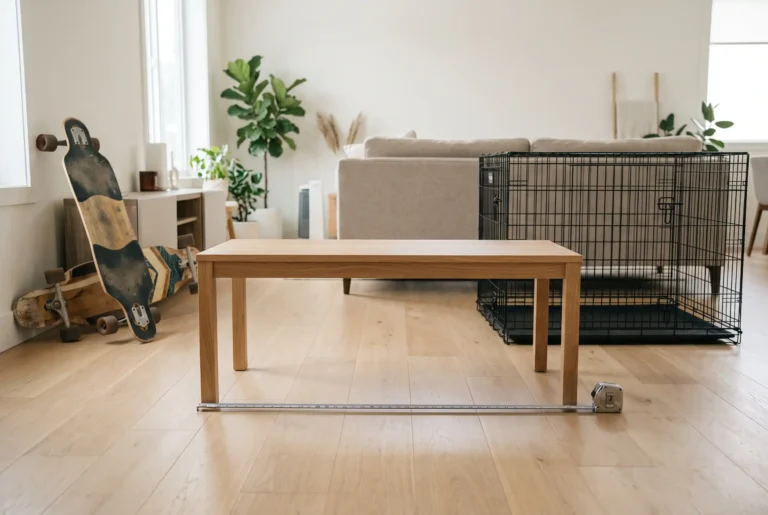
7. Small Coffee Table
A rectangular coffee table measuring 36 inches from end to end provides another straightforward household comparison.
Three-foot coffee tables are available for compact living rooms, smaller sofas, and seating arrangements where a longer table would take up too much space.
When selecting a table, measure both its length and the available walking clearance around it. Two tables with identical lengths can have very different footprints because of their widths.
8. Three-Foot-Wide Bookcase
Some freestanding bookcases measure 36 inches across the front, giving them a three-foot width.
This is helpful when evaluating whether a bookcase will fit inside a wall recess, between two pieces of furniture, or along a small office wall.
Bookcase widths vary considerably, so a model’s exact specifications matter more than a general furniture category. Also consider the bookcase’s depth, height, and required anti-tip anchoring.
9. Dining Chair Overall Height
Some dining chairs stand approximately 36 inches high when measured from the floor to the upper edge of the backrest.
This measurement describes the chair’s total height, not its seat height. Dining chair seats are commonly around 17 to 19 inches above the floor, depending on design.
A tall-backed dining chair can therefore help you visualize 36 inches vertically, but always check the actual chair dimensions.
10. Standard-Depth Sofa
Many sofas have overall depths in the general neighborhood of 36 inches, although shallow and deep-seated designs vary substantially.
Overall depth is measured from the sofa’s frontmost edge to the backmost part of its frame, not just across the usable seat cushion.
This distinction matters when determining how much floor space the sofa occupies or whether it can pass through a doorway.
11. Three-Foot-Wide Whiteboard
A whiteboard with a width of 36 inches provides a useful office or classroom example.
A frequently available whiteboard size is 24 by 36 inches, meaning the longer side measures exactly three feet.
When comparing products, pay attention to which dimension is listed first. Depending on its orientation, the 36-inch side may run horizontally or vertically.
12. Lateral Filing Cabinet
Lateral filing cabinets are sold in several widths, including 30, 36, and 42 inches. A 36-inch model stretches three feet across the front.
Unlike a narrow vertical file cabinet, a lateral unit generally has wide drawers designed to accommodate files in different arrangements.
The measurement is useful when planning office layouts, particularly if drawers need additional clearance to open fully.
13. Three-Foot-Wide Folding Table
Some rectangular folding tables are 36 inches wide. These are useful for events, craft activities, meetings, and temporary workstations.
For example, a table measuring 72 by 36 inches is six feet long and three feet wide.
Not every six-foot folding table is 36 inches wide. Many are narrower, so the width should be confirmed from the product specifications.
14. Adult Walking Cane
Some walking canes have a length of approximately 36 inches or include that measurement within their adjustable height range.
Walking canes differ according to the user’s height, arm proportions, shoes, and mobility requirements.
A cane should never be selected solely because it measures three feet. Proper fitting is more important than matching a convenient reference length, and a healthcare professional can assist when needed.
15. A 36-Inch Baseball Bat
Baseball bats are available in different lengths, and 36-inch models provide a recognizable sports-equipment example.
However, 36 inches is not a typical length for young children’s baseball bats. Bat selection depends on the player’s age, size, strength, and the rules of the applicable league.
A bat’s labeled length normally refers to its overall length from the knob to the end of the barrel.
16. Extra-Wide Yoga Mat
Some specialty yoga and exercise mats measure 36 inches wide, providing additional room for stretching and floor exercises.
Conventional yoga mats are often around 24 inches wide, so a three-foot-wide model offers substantially more lateral space.
This is an example of width rather than length. Most yoga mats are considerably longer than 36 inches to accommodate the user’s body.
17. Open Umbrella Canopy
Some compact and standard personal umbrellas have an open canopy span of approximately 36 inches.
The measurement usually describes the distance across the opened canopy, although manufacturers may specify arc length or diameter differently.
For an accurate comparison, check the product’s stated canopy dimensions rather than assuming all single-person umbrellas open to the same size.
18. Three-Foot Carpenter’s Level
A 36-inch spirit level is designed to measure three feet from end to end.
Levels help determine whether a surface is horizontal or vertical and are frequently used for hanging shelves, installing cabinets, and other home improvement tasks.
A level clearly labeled 36 inches is one of the more dependable physical examples because its nominal length is part of its product specification.
19. Three-Foot Wooden Dowel
Wooden dowels are sold in various lengths, including 36-inch pieces commonly used for crafts, woodworking, and household projects.
A three-foot dowel is a convenient visual reference because it is straight, lightweight, and easy to place next to another object.
For precision work, confirm the actual length, since cutting tolerances and product labeling can differ.
20. Three-Foot Folding Ruler
A folding measuring ruler with a total extended length of three feet provides an exact 36-inch reference when fully opened.
Unlike flexible measuring tapes, folding rulers have rigid sections that can help measure straight distances on flat surfaces.
Be sure the ruler is fully extended and aligned before comparing its length with another object.
How Long Is 36 Inches in Feet, Yards, and Centimeters?
36 inches equals exactly 3 feet, 1 yard, 91.44 centimeters, or 0.9144 meters. These conversions are based on internationally defined measurement relationships, not approximations.
| Measurement Unit | 36 Inches Equals | Calculation |
|---|---|---|
| Feet | 3 feet | 36 ÷ 12 |
| Yards | 1 yard | 36 ÷ 36 |
| Centimeters | 91.44 cm | 36 × 2.54 |
| Millimeters | 914.4 mm | 36 × 25.4 |
| Meters | 0.9144 m | 36 × 0.0254 |
| Feet and inches | 3 ft 0 in | Exactly three feet |
For a quick mental estimate, you can round 91.44 centimeters to about 91 centimeters or 0.91 meters. However, use the exact conversion when working with construction plans, furniture specifications, or any task requiring precision.
Is 36 Inches the Same as One Meter?
No. Although the measurements are reasonably close, 36 inches is shorter than one meter.
One meter measures approximately 39.37 inches, which makes it about 3.37 inches longer than a yard.
This difference can matter when measuring fabric, purchasing materials, or converting plans from metric to U.S. customary measurements.
How Many 12-Inch Rulers Make 36 Inches?
Exactly three rulers measuring 12 inches each will cover a distance of 36 inches when placed end to end.
The calculation is simple: 12 + 12 + 12 = 36 inches.
Make sure the ruler edges meet without gaps or overlaps. If the zero mark is set back from the physical end of a ruler, align measurements using the printed markings instead.
How Big Is 36 Inches Compared With a Person?
Three feet is a substantial distance for a household object, but it is much shorter than the height of most adults.
For someone who is 6 feet tall, 36 inches equals exactly half their height. For a person who is 5 feet 6 inches tall, it represents approximately 54.5% of their total height.
This does not mean 36 inches will reach the same point on everyone’s body. Torso length, leg proportions, and overall height vary.
What Does 36 Inches Look Like Vertically?
Picture a typical kitchen countertop. Its work surface is commonly positioned approximately three feet above the floor.
A 36-inch vertical measurement may also resemble the total height of some dining chair backs or certain small storage units.
These comparisons work especially well when estimating the height of a cabinet, decorative stand, or other piece of furniture.
What Does 36 Inches Look Like Horizontally?
Imagine a yardstick laid across the floor or a compact desk that stretches three feet from left to right.
A 36-inch-wide door slab also demonstrates the distance clearly. These horizontal examples are helpful when estimating available wall space or the width of an opening.
For reference, 36 inches is also three times the length of a standard 12-inch ruler.
36 Inches Compared With Other Common Lengths
Comparing 36 inches with shorter and longer measurements helps establish how much space three feet actually occupies.
| Length | Equivalent in Feet | Difference From 36 Inches |
|---|---|---|
| 12 inches | 1 foot | 24 inches shorter |
| 18 inches | 1.5 feet | 18 inches shorter |
| 20 inches | 1 foot 8 inches | 16 inches shorter |
| 24 inches | 2 feet | 12 inches shorter |
| 30 inches | 2.5 feet | 6 inches shorter |
| 36 inches | 3 feet | Exact reference |
| 40 inches | 3 feet 4 inches | 4 inches longer |
| 48 inches | 4 feet | 12 inches longer |
One particularly useful comparison is 24 inches versus 36 inches. While both are common furniture dimensions, 36 inches is 50% longer than 24 inches.
The extra foot can make a significant difference in a compact room, especially when positioning desks, shelving, and storage cabinets.
How to Measure 36 Inches Without a Tape Measure
You can measure approximately three feet using ordinary household items, even when a tape measure is unavailable. The best method depends on whether you need an exact result or a reasonable estimate.
Method 1: Use Three Standard Rulers
This is one of the most accurate alternatives when you have ordinary 12-inch rulers.
- Place the first ruler on a flat surface.
- Mark its 12-inch endpoint.
- Move the ruler forward so its zero mark aligns with the marked endpoint.
- Repeat the process until you have measured three complete 12-inch sections.
- Mark the final endpoint to identify the full 36-inch distance.
Alternatively, place three rulers end to end while carefully aligning their measuring scales.
Method 2: Use a Yardstick
A yardstick makes the process simpler because its full marked measurement already equals 36 inches.
Place the zero mark at the starting point, keep the yardstick straight, and read the 36-inch endpoint.
This method works well for measuring tabletops, shelves, boards, and floor spaces.
Method 3: Use Six U.S. Dollar Bills
A modern U.S. dollar bill measures approximately 6.14 inches along its longer side. Placing six bills end to end produces approximately 36.84 inches.
That is about 0.84 inches longer than three feet, making it a useful rough estimate rather than an exact measurement.
Keep the bills flat and avoid overlapping their edges. Even a small overlap can produce noticeable errors across several bills.
Method 4: Use Three Sheets of Letter-Size Paper
Standard U.S. letter paper measures 8.5 by 11 inches.
Three sheets positioned end to end along their 11-inch sides produce a combined distance of 33 inches. You would need another 3 inches to reach 36 inches.
This method is helpful when you only have paper and need to understand roughly how far three feet extends.
Method 5: Use a Verified Household Object
If you have a countertop, desk, or table known to measure exactly 36 inches along a particular dimension, you can use it as a reference.
For example, compare the height of an object against a kitchen countertop that you have previously measured.
Do not assume an object is exactly three feet merely because that measurement is common for its category.
When Does a 36-Inch Measurement Matter Most?
Understanding three-foot dimensions has practical benefits beyond estimating the size of objects. It can help with home organization, shopping, renovations, and everyday projects.
Furniture Shopping and Room Layouts
A 36-inch-wide desk or cabinet needs at least three feet of horizontal space for the furniture itself.
However, the available area should also accommodate baseboards, handles, electrical outlets, and room for movement when necessary.
Before purchasing furniture, measure the full installation area rather than relying on a rough visual comparison.
Kitchen and Bathroom Planning
Three feet is a useful reference because many standard kitchen work surfaces sit around 36 inches high.
Nevertheless, countertop height, cabinet width, appliance clearance, and accessible design requirements are separate considerations.
Do not assume that a 36-inch countertop height automatically establishes an appropriate width or clearance for other kitchen elements.
DIY Projects and Woodworking
Three-foot boards, dowels, levels, and rulers are convenient for small woodworking and household projects.
When cutting a piece to 36 inches, measure from a clearly established starting point and mark the cutting line accurately.
Account for the saw blade’s kerf, which is the material removed during cutting. Otherwise, your finished piece may be slightly shorter than intended.
Moving Furniture Through Doorways
A door described as 36 inches wide does not necessarily provide 36 inches of unobstructed clearance.
The installed door leaf, hinges, stops, and frame affect the usable opening.
Always measure the actual clear opening and compare it with the furniture’s dimensions in the orientation required for moving it.
Everyday Objects That Measure 13 Inches Long
Common Mistakes When Estimating 36 Inches
Three feet may be a familiar measurement, but several common mistakes can make visual comparisons misleading.
Confusing Length With Width or Height
A desk described as 36 inches wide is not necessarily 36 inches deep or tall.
Likewise, a kitchen countertop may be approximately 36 inches high while its depth is significantly smaller.
Always identify the dimension being measured before making a comparison.
Assuming Standard Means Exact
Manufacturers produce objects in different sizes, even when one dimension is widely used.
For example, not every dining chair reaches 36 inches high, and not every curtain rod measures three feet when installed.
A familiar product category provides a useful estimate but does not guarantee a specific measurement.
Using Clothing Sizes as Straight-Line Measurements
Men’s pants marked with a 36-inch waist size provide a useful example of a common number, but the size label generally refers to a nominal waist circumference.
It does not mean the waistband measures 36 inches across when the pants are laid flat. A circumference describes the distance around a shape, rather than a single straight-line span.
Actual garment measurements can also differ from labeled sizes depending on the brand and fit.
Confusing Nominal and Actual Dimensions
Products such as building materials, cabinets, and doors sometimes use nominal measurements, which may differ from their precise finished dimensions.
A measurement advertised as 36 inches can therefore require closer inspection if the object must fit into a tight opening.
Use actual product specifications and physical measurements for installations where small differences matter.
Ignoring the Starting Point
Accurate measuring requires beginning at the correct zero mark.
Some rulers have an unmarked margin before zero, and a measuring tape’s end hook can move slightly as part of its design.
For more reliable results, align the measuring markings correctly and keep the tool straight.
Which 36-Inch Examples Are Best for Quick Comparisons?
The most helpful example depends on what you are trying to measure. A rigid measuring tool is best for accuracy, while a familiar piece of furniture works well for visualization.
| Situation | Best Reference | Why It Helps |
|---|---|---|
| Accurate length measurement | Yardstick | Measures one yard directly |
| Estimating object height | Verified 36-inch countertop | Easy vertical reference |
| Estimating furniture width | 36-inch desk | Shows horizontal space requirements |
| Planning doorway clearance | Measured door opening | Reflects usable space |
| DIY measurements | Three-foot level or ruler | Rigid straight reference |
| Estimating room dimensions | Three 12-inch ruler lengths | Repeatable without specialized tools |
For precise work, an actual measuring tool remains the best choice. Familiar objects are most useful for understanding scale, not replacing accurate measurement.
Remembering What 36 Inches Looks Like in Everyday Life
36 inches is exactly 3 feet or one yard, and the easiest object to associate with that measurement is a yardstick. Other practical comparisons include a typical kitchen countertop’s height, a three-foot-wide desk, a 36-inch door slab, and certain coffee tables or bookcases.
When estimating dimensions, remember that some objects are manufactured to an exact three-foot size while others merely come close. Use those familiar examples to understand scale, but confirm the actual measurement before buying furniture, cutting materials, or planning installations.
Frequently Asked Questions
How long is 36 inches in feet?
36 inches equals exactly 3 feet because one foot contains 12 inches. Dividing 36 by 12 gives a total of three feet.
Is 36 inches exactly one yard?
Yes, 36 inches is exactly one yard in the U.S. customary measurement system. A standard yardstick measures this distance directly.
How many centimeters are in 36 inches?
There are exactly 91.44 centimeters in 36 inches. Multiply the number of inches by 2.54 to convert inches into centimeters.
What household item is exactly 36 inches long?
A full-size yardstick is exactly 36 inches long by definition. A rigid level or dowel specifically manufactured and labeled as 36 inches can also provide a three-foot reference.
Is a kitchen countertop always 36 inches high?
No, although approximately 36 inches is a common finished countertop height in American kitchens. Custom, accessible, and specialized work surfaces can have different heights.
Is a 36-inch door three feet wide?
A door slab with a nominal width of 36 inches is three feet wide. The actual clear opening after installation may be smaller because of the door frame, hinges, and door position.
Can I measure 36 inches using dollar bills?
Six U.S. dollar bills placed end to end along their long edges measure approximately 36.84 inches. That is slightly longer than 36 inches, so this method is suitable for estimation rather than precise measuring.
Are 36 inches and one meter the same length?
No, 36 inches equals 0.9144 meters, while one meter is approximately 39.37 inches. A meter is therefore about 3.37 inches longer than three feet.