20 Common Things That Are 96 Inches Long (Everyday Examples)
96 inches is exactly 8 feet, or 243.84 centimeters (2.4384 meters). Common things that are 96 inches long include 8-foot folding tables, 4-by-8-foot plywood sheets, drywall panels, lumber boards, fence panels, area rugs, and some sofas. This measurement is especially common in American homes, construction materials, furniture, and outdoor equipment.
Visualizing 96 inches becomes easier when you compare it with familiar objects. The examples below explain which items measure exactly 8 feet, which are approximately that size, and how to use them for practical measurements. For more helpful everyday measurement guides, visit Snap Planets.
Key Takeaways
- 96 inches equals exactly 8 feet, 2.6667 yards, 243.84 centimeters, or 2.4384 meters.
- Standard 4-by-8-foot drywall, plywood, and OSB panels have one side measuring 96 inches.
- Eight-foot folding tables, selected fence panels, and 8-foot-long rugs provide useful real-world comparisons.
- An 8-foot ceiling or an 8-foot-tall door can help you visualize 96 inches vertically, although these dimensions are not universal.
- For furniture, doors, vehicles, and equipment, always verify the actual dimensions because advertised sizes may be rounded or nominal.
What Does 96 Inches Look Like in Real Life?
Imagine an 8-foot folding table stretched across a room or the long edge of a standard sheet of plywood. That distance is 96 inches. It is also equivalent to eight standard 12-inch rulers placed end to end without gaps or overlaps.
For a person who is 6 feet tall, 96 inches is 2 feet longer than their height. A standard 80-inch-tall residential door, including many common interior door slabs, is 16 inches shorter than 96 inches.
The measurement also appears vertically. In a room with an 8-foot ceiling, the floor-to-ceiling distance is approximately 96 inches, although the actual finished height may vary.
96 Inches Conversion Chart
| Measurement Unit | Equivalent to 96 Inches |
|---|---|
| Feet | 8 feet |
| Feet and inches | 8 feet, 0 inches |
| Yards | 2.6667 yards (approximately) |
| Centimeters | 243.84 cm |
| Millimeters | 2,438.4 mm |
| Meters | 2.4384 m |
| Millimeters to inches ratio | 25.4 mm per inch |
To convert inches into feet, divide the number of inches by 12. Therefore, 96 ÷ 12 = 8 feet. For centimeters, multiply inches by 2.54, which gives 96 × 2.54 = 243.84 centimeters.
These conversions are exact except where the displayed decimal is rounded.
20 Everyday Things That Are 96 Inches Long or Close to It
Some of the following objects are manufactured in exact 96-inch sizes. Others come in several dimensions, with an 8-foot version available. Knowing the difference matters, particularly when measuring for furniture, buying construction supplies, or planning a room layout.
1. Standard Drywall Sheet
A common drywall sheet measures 4 feet wide by 8 feet long, giving it a length of exactly 96 inches and a width of 48 inches. Drywall is the familiar gypsum-based panel used to finish interior walls and ceilings.
The 4-by-8-foot size is widely available at home improvement stores. Larger and longer sheets are also manufactured, including 10-foot and 12-foot options.
If you have seen contractors carrying rectangular wallboard panels into a house, the longer edge of an 8-foot sheet offers a useful visual reference for 96 inches.
2. Standard Plywood Panel
A common full-size plywood sheet measures 48 by 96 inches. Plywood is made by bonding layers of wood veneer together, with the grain direction generally alternating between adjacent layers.
The familiar 4-by-8-foot panel is used for subflooring, wall sheathing, cabinets, furniture, and various woodworking projects.
Although a full sheet provides a reliable 8-foot comparison, not every plywood panel has these dimensions. Some specialty and pre-cut panels are smaller, and actual dimensions can vary by product.
3. Oriented Strand Board (OSB)
Oriented strand board, commonly called OSB, is another engineered wood product frequently sold in 4-by-8-foot sheets. That means its nominal long dimension is 96 inches.
OSB panels contain wood strands bonded with adhesives under heat and pressure. They are commonly used for roof decking, wall sheathing, and structural subfloor applications when the appropriate grade and thickness are selected.
In a lumberyard, a full-size OSB sheet and a standard plywood sheet provide nearly identical length references.
4. Eight-Foot 2-by-4 Lumber
An 8-foot 2-by-4 is one of the easiest construction materials to recognize as a 96-inch object. It is commonly sold for framing, bracing, shelves, and general home improvement work.
The name 2-by-4 refers to its nominal cross-sectional size, not its finished dimensions. A typical surfaced 2-by-4 measures approximately 1.5 inches by 3.5 inches across its cross section.
Its advertised length, however, is 8 feet for an 8-foot board. Certain precut framing studs are shorter, so check the label before assuming a board is exactly 96 inches long.
5. Eight-Foot 2-by-6 Board
A 2-by-6 board sold in an 8-foot length provides another straightforward 96-inch example. This lumber is commonly used in framing, decking structures, and woodworking, depending on the type and grade.
The finished cross section of a typical surfaced 2-by-6 is approximately 1.5 inches by 5.5 inches, while the nominal 8-foot length is 96 inches.
The wider face makes it easy to distinguish from a 2-by-4, even though both can be purchased in identical lengths.
6. Eight-Foot PVC Pipe
PVC pipe is often sold in long, straight sections, including 8-foot lengths from some retailers and manufacturers. An 8-foot section measures 96 inches before any cutting.
PVC pipes are available in different diameters, wall thicknesses, and types for applications such as plumbing, irrigation, drainage, and electrical conduit, depending on the product.
Because 10-foot and 20-foot lengths are also common, the length must be checked before using a PVC pipe as an exact reference.
7. Eight-Foot Vinyl Fence Panel
Many residential vinyl fencing systems offer panels with a nominal width of 8 feet, or 96 inches. These panels are commonly used for backyard boundaries, privacy fences, and decorative enclosures.
Fence panel dimensions depend on the design and manufacturer. A product advertised for 8-foot post spacing may have an actual panel width slightly shorter than 96 inches to accommodate posts and installation hardware.
For a quick comparison, imagine the distance between two fence posts spaced approximately 8 feet apart.
8. Eight-Foot Garden Lattice Panel
Decorative lattice panels are available in 4-by-8-foot formats, with one edge measuring 96 inches. They are commonly used for garden screens, trellises, deck skirting, and privacy features.
Lattice can be made from wood, vinyl, or composite materials. The crisscross pattern creates openings that allow air and some light to pass through.
A full-size lattice sheet provides a particularly useful reference because you can visualize both 48 inches and 96 inches within the same panel.
9. Eight-Foot Raised Garden Bed
Raised garden beds can be built or purchased in rectangular layouts measuring 8 feet long. Their 96-inch sides create room for multiple planting sections, although width and depth depend on the chosen design.
For example, a garden bed that measures 8 feet long and 4 feet wide has a rectangular footprint of 32 square feet.
This size is practical for understanding garden layout, but an 8-foot bed should not be confused with a universal standard. Raised beds come in many lengths and configurations.
10. Eight-Foot Folding Banquet Table
An 8-foot rectangular folding table measures 96 inches long. These tables are commonly used for wedding receptions, buffets, classrooms, community events, and temporary workspaces.
Typical rectangular banquet tables are sold in several lengths, including 4, 6, and 8 feet. An 8-foot version is easy to recognize because it is substantially longer than an ordinary dining table for four people.
Depending on chair size and spacing, an 8-foot banquet table can often accommodate around eight people, with seating arrangements varying by event.
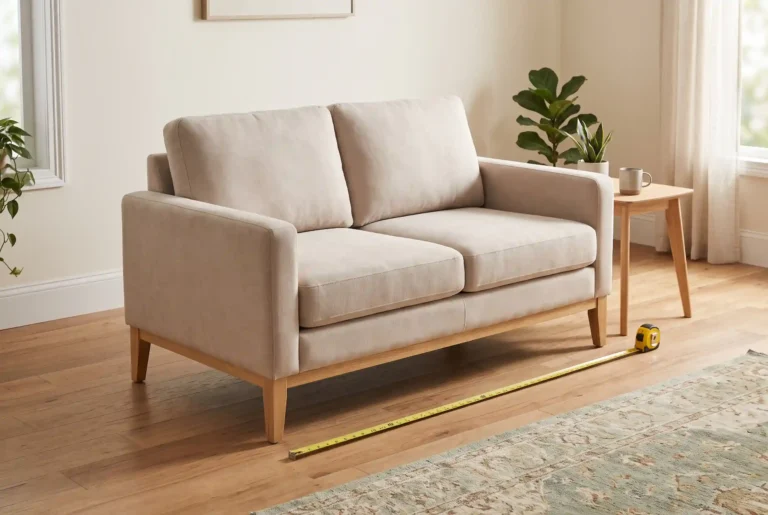
11. Large Three-Seat Sofa
Some large three-seat sofas measure approximately 96 inches from one outer arm to the other. This makes them useful examples of furniture that can occupy a full 8-foot stretch of wall.
However, there is no single universal sofa length. Compact sofas may be significantly shorter, while oversized sofas and sectional arrangements can be much longer.
If you are considering a 96-inch sofa for your living room, allow additional room for walkways, side tables, and access to nearby doors.
12. Eight-Foot Area Rug
A rug labeled 5 feet by 8 feet has nominal dimensions of 60 by 96 inches. The longer side is therefore a convenient reference for an 8-foot distance.
Area rugs of this size are often placed in bedrooms, living rooms, and home offices. They can help define a seating area or provide a soft surface alongside furniture.
Actual rug dimensions may vary slightly from the advertised size. This is especially important when fitting a rug into a tight space or arranging furniture around its edges.
Common everyday examples measuring 1.375 inches
13. Eight-Foot-Tall Interior Door
Some residential and commercial interior doors are manufactured at 96 inches tall. These are often described as 8-foot doors and are used in buildings designed with taller openings.
It is important to distinguish an 8-foot door from the common 80-inch residential interior door. The two are not interchangeable, and 96 inches should not be assumed to be the typical height of every doorway.
An 8-foot door provides a simple vertical comparison, especially when you are trying to picture 96 inches standing upright instead of lying horizontally.
14. Eight-Foot Sliding Patio Door
Sliding patio doors are available in configurations measuring approximately 8 feet wide. A 96-inch-wide assembly can create a large opening between an interior living space and a patio or deck.
Sliding doors are offered in many widths and heights. Some products described as 8-foot patio doors are approximately 96 inches wide, while other models are 96 inches tall.
When ordering a door, confirm whether the stated measurement refers to overall frame width, panel width, height, or the rough opening required for installation.
15. Eight-Foot Ceiling Height
An 8-foot-high ceiling has a floor-to-ceiling height of 96 inches. This is a familiar ceiling height in many American homes, although homes may also have 9-foot, 10-foot, vaulted, or other ceiling configurations.
An 8-foot ceiling makes it particularly easy to visualize the length of a standard drywall sheet or lumber board. Standing a full 8-foot object vertically in a room of this height shows why installation clearance matters.
The finished ceiling height should always be measured directly. Framing dimensions and finished room dimensions are not necessarily identical.
16. Eight-Foot Workbench
A long garage or workshop workbench can measure 96 inches from end to end. This gives users an extended surface for assembling furniture, handling tools, or organizing materials.
Eight-foot workbenches may be built from lumber, metal framing, or ready-made modular systems. Their depths and heights vary according to the intended work.
For example, a 96-inch-long workbench with a 24-inch depth provides 16 square feet of rectangular work surface before accounting for equipment and accessories.
17. Eight-Foot Retail Display Shelf
Retail shelving can be arranged into 8-foot-long runs using modular sections. Some individual commercial shelf components are also available in longer sizes, depending on the manufacturer and intended load.
In stores, multiple smaller shelving units often connect to form a continuous display. Therefore, an 8-foot shelving run does not necessarily mean that every individual shelf is 96 inches long.
This distinction matters when planning a home workshop, garage, storage room, or commercial display area.
18. Eight-Foot Recreational Kayak
Compact recreational kayaks are available in 8-foot models that measure 96 inches from bow to stern. They are shorter than many touring or recreational kayaks, which can extend well beyond 10 feet.
An 8-foot kayak makes an interesting outdoor reference because its overall length is similar to an 8-foot folding table, even though the shapes are completely different.
Kayak length affects transport and storage considerations, but it is not enough by itself to determine stability, tracking, weight capacity, or suitability for particular water conditions.
19. Eight-Foot Pickup Truck Bed
Some full-size pickup trucks have cargo beds described as 8-foot beds. These long-bed configurations are especially useful for transporting lumber, tools, and construction materials.
The precise inside bed length varies by truck manufacturer and model. A bed advertised as 8 feet may measure slightly more or less than exactly 96 inches.
For example, a truck bed measuring 97 inches is approximately 8 feet long, but it is still one inch longer than 96 inches.
When transporting an 8-foot board or sheet, check the usable cargo length, tailgate position, wheel-well clearance, and applicable load-securing requirements.
20. Eight-Foot Portable Stage Section
Modular event staging platforms are available in 4-by-8-foot configurations. The longer side of an 8-foot platform measures 96 inches, providing a useful comparison for event spaces.
These sections can be combined to create larger stages for presentations, performances, school events, and ceremonies.
The platform’s height, supported load, attachment system, and exact outside dimensions depend on the staging product. An 8-foot stage deck is a length reference, not a guarantee that all portable stages share the same dimensions.
Quick Comparison of 96-Inch Objects
The table below separates common exact-size examples from items that merely have 8-foot versions. This helps avoid assuming that every sofa, door, or kayak measures the same length.
| Object | Typical Relevant Dimension | Measurement Reliability |
|---|---|---|
| 4-by-8 drywall sheet | 96-inch long side | Exact nominal panel size |
| 4-by-8 plywood sheet | 96-inch long side | Exact nominal panel size |
| 4-by-8 OSB sheet | 96-inch long side | Exact nominal panel size |
| 8-foot lumber board | 96-inch length | Specified stock length |
| 8-foot banquet table | 96-inch length | Common advertised size |
| 5-by-8 area rug | 96-inch long side | Nominal size, may vary |
| Large sofa | Around 96 inches wide | Model dependent |
| 8-foot interior door | 96-inch height | Specific tall-door size |
| 8-foot pickup bed | Approximately 96 inches | Vehicle dependent |
| Compact 8-foot kayak | 96-inch overall length | Model dependent |
| 8-foot fence panel | Approximately 96-inch span | System dependent |
| 8-foot ceiling | 96-inch vertical height | Depends on finished room |
How Does 96 Inches Compare With Other Common Lengths?
Another way to visualize 96 inches is to compare it with shorter or longer objects and measurements you already recognize.
| Length | Equivalent in Feet | Comparison With 96 Inches |
|---|---|---|
| 12 inches | 1 foot | One-eighth as long |
| 24 inches | 2 feet | One-quarter as long |
| 36 inches | 3 feet | 60 inches shorter |
| 48 inches | 4 feet | Half as long |
| 60 inches | 5 feet | 36 inches shorter |
| 72 inches | 6 feet | 24 inches shorter |
| 80 inches | 6 feet 8 inches | 16 inches shorter |
| 96 inches | 8 feet | Exact target length |
| 108 inches | 9 feet | 12 inches longer |
| 120 inches | 10 feet | 24 inches longer |
A particularly simple comparison involves a standard king-size mattress. A king mattress is nominally 76 inches wide and 80 inches long, making its length 16 inches shorter than 96 inches. A California king mattress, typically 84 inches long, is 12 inches shorter.
These comparisons are useful when estimating how much space a large object requires in a bedroom or living area.
Where Is the 96-Inch Measurement Most Common?
Eight-foot dimensions appear frequently because they fit familiar construction and product-sizing systems. However, their importance differs across industries.
Residential Construction
Standard 4-by-8-foot sheet goods are widely used in building construction. Drywall, plywood, OSB, and certain sheathing products share this convenient nominal panel size.
For some wall configurations, an 8-foot panel can cover much of the vertical surface. Actual framing and installation methods must account for floor assemblies, ceiling finishes, joints, gaps, and material requirements.
Not every wall or ceiling is 8 feet high, so the panel length is not always equal to the finished wall height.
Furniture and Interior Layouts
Furniture manufacturers frequently use dimensions close to 8 feet for large sofas, long tables, and storage units.
In a room layout, 96 inches is enough space for substantial furniture. However, a piece measuring exactly 96 inches should not be installed into a nominal 96-inch opening without checking clearances and any obstacles.
Outdoor Projects
Eight-foot dimensions are common in garden structures, fence layouts, and some landscaping products. The length makes it convenient to plan rectangular beds, straight fence runs, and outdoor platforms.
Outdoor projects still require accurate measurements because posts, brackets, ground conditions, and assembled product dimensions can change the space required.
How to Measure 96 Inches Accurately
If you need an actual 96-inch distance, a measuring tool is more reliable than estimating from household objects.
- Choose a suitable measuring tape. A 12-foot or 25-foot tape measure can measure 96 inches in one continuous span.
- Identify the starting point. Place the zero mark at the edge of the object or the beginning of the desired distance.
- Extend the tape straight. Avoid twists, bends, and sagging that can affect your reading.
- Locate the 96-inch mark. On many U.S. tape measures, this aligns with the 8-foot mark.
- Mark the endpoint. Use a pencil or another removable marker appropriate for the surface.
- Measure again. Double-check the distance before cutting materials, drilling holes, or ordering furniture.
Measuring Without a Long Tape
If a tape measure is unavailable, you can use a ruler or another object of known dimensions.
- Place eight 12-inch rulers consecutively to cover 96 inches.
- Measure four consecutive 24-inch sections.
- Use two carefully measured 48-inch sections.
- Use a full-length 8-foot board as a reference after verifying its actual length.
Mark each endpoint carefully and avoid gaps between repeated measurements. Small positioning errors can accumulate over an 8-foot distance.
For construction work or installations requiring precision, always use a suitable calibrated measuring tool instead of relying on a visual comparison.
How Much Space Does a 96-Inch Object Need?
An object that is 96 inches long does not necessarily fit comfortably into an opening that is exactly 96 inches long. You may need extra space for moving, handling, assembly, or everyday use.
For Furniture
A 96-inch sofa needs an appropriate wall area, plus clearance where people walk around it. Nearby doors, drawers, and other furniture should remain accessible.
If a sofa is placed between two fixed walls, the actual available width should exceed the furniture’s outside dimensions enough to permit installation.
For Tables
An 8-foot banquet table requires significantly more room than its physical footprint. Chairs need space, and seated guests should be able to move without blocking circulation routes.
The complete space requirement depends on the table’s width, the seating arrangement, and the room’s intended use.
For Building Materials
Transporting an 8-foot sheet of plywood or drywall requires more consideration than transporting an 8-foot narrow board. A 4-by-8-foot panel has a width of 48 inches as well as a length of 96 inches.
When moving panels through hallways and doors, consider turning clearance, diagonal orientation, and the possibility of damaging finished surfaces.
Common Measurement Mistakes to Avoid
Even a straightforward 8-foot measurement can cause confusion when advertised sizes and actual dimensions are different.
- Confusing height with length: A door may measure 96 inches tall, while a table measures 96 inches horizontally. Both describe the same distance in different orientations.
- Assuming all standard doors are 8 feet tall: Many common residential interior doors are 80 inches tall, not 96 inches.
- Confusing nominal and actual sizes: A 2-by-4 does not measure exactly 2 by 4 inches across its finished cross section.
- Using approximate objects as exact rulers: Sofas, pickup beds, rugs, and fence panels can differ from their advertised dimensions.
- Ignoring surrounding clearance: A 96-inch opening is not automatically sufficient for every 96-inch product.
- Mixing inches and centimeters: Always confirm that measurements use the same unit before comparing them.
Is 96 Inches a Standard Size in Sports?
Sports equipment and playing areas offer several useful size comparisons, but it is important not to confuse nearby measurements with exactly 96 inches.
For example, a regulation table tennis table is 9 feet long, or 108 inches. It is 12 inches longer than 96 inches, according to the dimensions published by USA Table Tennis.
Similarly, the NBA free throw lane is 16 feet wide, not 8 feet. The official NBA court rules provide the regulation court layout and markings.
Selected portable sports equipment, training mats, and recreational products may come in 8-foot lengths, but their actual measurements depend on the product rather than a universal sporting standard.
Understanding 96 Inches Through Familiar Objects
96 inches is exactly 8 feet, and some of the easiest objects to use for visualizing this length are standard 4-by-8-foot plywood or drywall panels, 8-foot lumber, rectangular banquet tables, and 8-foot-long area rugs. These provide practical comparisons for both home and construction projects.
Other items, including sofas, doors, kayaks, pickup beds, and fence panels, can measure approximately 96 inches, but their dimensions vary by model. Use these examples for estimating distance, and check the actual measurements whenever fit, safety, or precision matters.
Everyday items that measure 34 inches long
Frequently Asked Questions
How many feet is 96 inches?
96 inches equals exactly 8 feet because one foot contains 12 inches. Dividing 96 by 12 gives 8 with no remainder.
What common household object is 96 inches long?
An 8-foot folding table or a 5-by-8-foot area rug provides a familiar example of a 96-inch length. Some large sofas also measure approximately 96 inches wide, although sofa dimensions vary.
How many centimeters is 96 inches?
96 inches equals exactly 243.84 centimeters. Multiply 96 by 2.54 to convert inches to centimeters.
Is 96 inches the same as 8 feet or 8 yards?
96 inches is exactly 8 feet, not 8 yards. Eight yards equals 288 inches, which is three times as long.
Is a standard door 96 inches tall?
Some tall interior and exterior doors measure 96 inches in height, but many common U.S. residential interior doors are 80 inches tall. Always check the specific door slab and frame dimensions before making an installation plan.
Is 96 inches longer than a king-size mattress?
Yes, a standard king-size mattress is nominally 80 inches long, so 96 inches is 16 inches longer. The mattress is also typically 76 inches wide, while the dimensions of its bed frame may be larger.
Can an 8-foot board fit inside a pickup truck?
An 8-foot board may fit within the usable cargo length of a pickup equipped with a suitable long bed, but exact dimensions vary by vehicle. Measure the inside bed and secure the load properly before transporting it.
How can I picture 96 inches without a measuring tape?
Imagine eight one-foot rulers placed end to end, the long edge of a 4-by-8-foot plywood sheet, or an 8-foot folding table. These comparisons make it easier to estimate the distance, but a measuring tape is preferable when you need an accurate result.