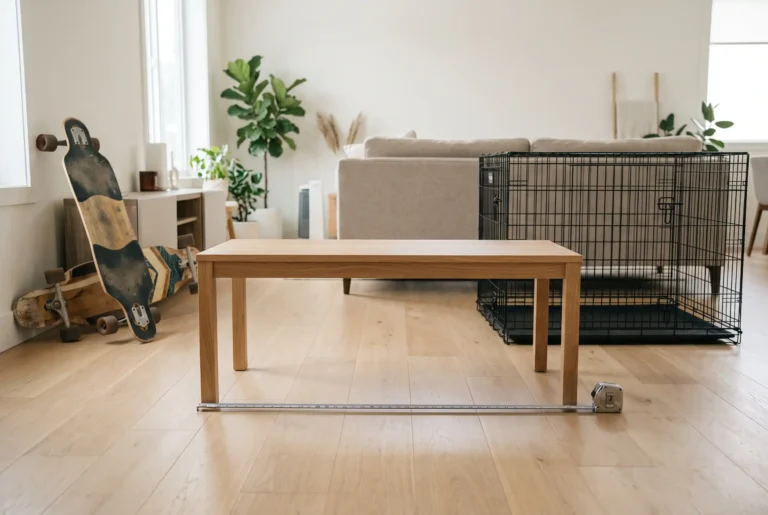
17 Common Things That Are 20 Inches Long (Everyday Examples)
Things that are 20 inches long include the short side of a standard bed pillow, a 20-inch square throw pillow, a large cutting board, a 20-inch picture print, and certain rolling pins, suitcases, and computer screens. Exactly 20 inches equals 1 foot 8 inches or 50.8 centimeters, making it a useful measurement for comparing everyday household objects.
Some objects have a standardized 20-inch dimension, while others are available in different sizes and provide only approximate comparisons. Understanding those differences helps you estimate length more accurately when shopping, arranging furniture, or measuring without a ruler. For more practical measurement guides and everyday comparisons, visit Snap Planets.
Key Takeaways
- 20 inches equals exactly 50.8 centimeters, 508 millimeters, or 1 foot 8 inches.
- A standard American bed pillow typically measures 20 by 26 inches, giving you a convenient 20-inch reference.
- Items such as 20-by-20-inch throw pillows, square canvases, and 16-by-20-inch prints provide reliable examples when their labeled dimensions match.
- Four typical 12-ounce soda cans placed end to end by height measure approximately 19.3 inches, slightly shorter than 20 inches.
- Screen sizes and luggage labels require care because a 20-inch diagonal screen or nominal suitcase size does not necessarily indicate its overall width or exterior height.
17 Everyday Things That Are 20 Inches Long
Twenty inches is longer than a typical school ruler but shorter than a standard yardstick. It is a manageable length that appears in bedroom furnishings, kitchen equipment, travel accessories, artwork, and electronic devices.
The following examples include objects with a specified 20-inch dimension and products that are commonly available in sizes close to it. Whenever a product comes in multiple sizes, its actual measurement should be checked rather than assumed.
| Everyday Object | 20-Inch Reference | Accuracy |
|---|---|---|
| 1. Standard bed pillow | Shorter side | Typically 20 inches |
| 2. Square throw pillow | Either side of a 20-by-20 pillow | Nominally exact |
| 3. Picture print | Long side of a 16-by-20 print | Exact print dimension |
| 4. Large cutting board | Long edge of a 20-inch model | Size-dependent |
| 5. French rolling pin | Overall length | Some models are 20 inches |
| 6. Large serving platter | Longest edge | Approximate |
| 7. Four soda cans | Combined heights | About 19.3 inches |
| 8. Carry-on suitcase | Nominal height | Model-dependent |
| 9. Extendable back scratcher | Extended length | Approximate |
| 10. Large laptop bag | Exterior width | Model-dependent |
| 11. Computer monitor | Screen diagonal | 20 inches if labeled accordingly |
| 12. Small television | Screen diagonal | 20 inches if labeled accordingly |
| 13. Compact soundbar | Overall width | Size-dependent |
| 14. Small training bat | Overall length | Some models are 20 inches |
| 15. Foam roller | Length of roller | Size-dependent |
| 16. Square painting canvas | Either side of a 20-by-20 canvas | Nominally exact |
| 17. Newborn baby | Head-to-heel length | Approximately 20 inches |
1. Standard Bed Pillow
A standard-size American bed pillow typically measures 20 inches wide and 26 inches long. Its shorter side is an especially useful reference because the dimension is consistent across many standard pillow products.
Place the pillow flat and measure from one side seam to the other along its shorter edge. The stated pillow size is a nominal measurement, so a filled pillow may appear slightly different depending on its shape and construction.
2. Large Square Throw Pillow
Decorative throw pillows are available in numerous sizes, including 20 by 20 inches. A pillow with these dimensions gives you four sides that represent approximately 20 inches each.
This example is convenient for planning sofa arrangements or comparing furniture dimensions. Keep in mind that a removable pillow cover and its insert may have different labeled sizes to create a fuller appearance.
3. A 16-by-20-Inch Photograph or Art Print
A photograph printed at 16 by 20 inches has one side measuring exactly 20 inches. This is a straightforward reference for home decorating, framing, and wall art projects.
The distinction between the print and its frame matters. A frame made to hold a 16-by-20-inch photograph generally has exterior dimensions larger than the print because of the surrounding frame material.
4. Large Kitchen Cutting Board
Large rectangular cutting boards are available in dimensions such as 20 by 14 inches. Their longer edge provides a practical representation of 20 inches across a kitchen counter.
Cutting boards vary considerably, so a board should only be treated as an accurate reference if its stated dimensions or direct measurement confirm the length. A 20-inch board also helps illustrate how much preparation space a large cutting surface provides.
5. French Rolling Pin
French-style rolling pins are long, handleless tools used to roll pastry, pie dough, and other baking mixtures. Some models measure approximately 20 inches from end to end.
Their lengths are not standardized across all manufacturers. Checking the product dimensions provides a better reference than relying on the rolling pin’s appearance alone.
6. Large Oval Serving Platter
Oversized serving platters used for roasted meats, holiday meals, or shared dishes sometimes measure about 20 inches along their longest dimension.
An oval platter is measured across its maximum length, not around its curved perimeter. This makes it a helpful comparison when determining whether a large platter will fit inside a cabinet, serving area, or dishwasher.
7. Four Standard Soda Cans Placed End to End
A typical standard-profile 12-fluid-ounce aluminum beverage can is approximately 4.83 inches tall. Placing four upright-can heights end to end creates a combined length of about 19.32 inches.
That is approximately 0.68 inches shorter than 20 inches. Can dimensions vary with packaging designs, so this method works for rough estimates rather than precision measurements.
For the easiest comparison, lay four cans horizontally with their tops and bottoms aligned in a straight line, measuring along their height rather than their diameter.
8. A 20-Inch Carry-On Suitcase
Some compact rolling suitcases are advertised as 20-inch luggage. The number may describe the main case body or a nominal product size rather than the total external height.
Wheels, handles, and other protruding parts can increase the overall dimensions. This distinction is especially important when checking airline carry-on requirements because airlines may measure the entire bag, including its fixed exterior components.
9. Extendable Back Scratcher
Back scratchers are designed to help reach areas that are difficult to access with your hands. Some fixed-length or telescoping models extend to approximately 20 inches.
Because the product’s length varies by design, an extended 20-inch back scratcher is a useful visual comparison only when the dimensions are known. A telescoping version can also demonstrate how much longer 20 inches looks compared with its compact storage length.
10. Large Laptop Carrying Bag
Some large laptop briefcases and carrying bags approach 20 inches in exterior width, especially models designed for larger laptops and additional accessories.
Not every bag intended for a 15-inch or 17-inch laptop is 20 inches wide. Laptop screen sizes refer to the display diagonal, while a bag’s exterior width depends on its design, padding, and storage compartments.
11. A 20-Inch Computer Monitor
A computer monitor advertised as 20 inches has a screen measuring approximately 20 inches diagonally. The diagonal runs from one corner of the visible display area to the opposite corner.
For a 20-inch display with a 16:9 aspect ratio, the screen area is approximately 17.43 inches wide and 9.81 inches high. Bezels and the housing increase the overall exterior dimensions.
This means a 20-inch monitor provides an accurate diagonal reference, but its horizontal width is less than 20 inches.
12. A 20-Inch Television
Television screen sizes use the same diagonal convention as computer monitors. A television described as 20 inches measures 20 inches diagonally across its display, rather than across the entire television cabinet.
Screen width changes with aspect ratio, and the outer housing adds additional space. If you are choosing a television for a narrow shelf, consult its overall width and depth rather than relying only on the advertised screen size.
13. Compact Television Soundbar
Compact soundbars are available in widths around 20 inches. These shorter audio devices may fit beneath small televisions or on narrow desks and entertainment shelves.
Soundbars have no universal 20-inch sizing standard. Some are considerably longer, so checking their dimensions is necessary before using them as a reliable measuring reference.
14. Small Children’s Training Bat
Very short training bats and beginner batting products can measure approximately 20 inches. These are smaller than many conventional youth baseball bats, which are commonly offered in longer lengths.
A 20-inch bat provides a recognizable example of the measurement, but it should not automatically be considered appropriate for a particular child. Bat selection also depends on the player’s size, strength, equipment rules, and intended activity.
15. Medium-Length Foam Roller
Foam rollers used for exercise and muscle self-massage come in a range of lengths, including compact versions, intermediate options, and full-length rollers. Some are approximately 20 inches long.
The length affects how much surface area the roller can support during use. For measurement comparisons, use the distance between its two flat ends rather than its circumference or diameter.
16. A 20-by-20-Inch Painting Canvas
A square artist’s canvas labeled 20 by 20 inches provides a particularly clear example because both its height and width are nominally 20 inches.
It can be positioned vertically or horizontally without changing the reference dimension. Whether it is a stretched canvas or a canvas panel, the labeled outer dimensions provide a simple way to visualize a square with 20-inch sides.
17. Length of a Newborn Baby
A newborn’s head-to-heel length is often near 20 inches, although healthy babies vary considerably in size. Birth length depends on factors including gestational age and individual growth.
This is best understood as a familiar biological comparison rather than a measuring standard. Healthcare professionals measure infant length while the baby is lying down, since newborns cannot stand for height measurements.
How Long Is 20 Inches in Feet, Centimeters, and Other Units?
Twenty inches equals exactly 50.8 centimeters. In US customary units, it equals 1 foot and 8 inches, or approximately 1.67 feet expressed as a decimal.
These conversions are based on defined measurement relationships, so they do not depend on the type of object being measured.
| Measurement Unit | Equivalent to 20 Inches |
|---|---|
| Inches | 20 in |
| Feet and inches | 1 ft 8 in |
| Decimal feet | 1.6667 ft (approx.) |
| Centimeters | 50.8 cm |
| Millimeters | 508 mm |
| Meters | 0.508 m |
| Yards | 0.5556 yd (approx.) |
Converting 20 Inches to Centimeters
One international inch is defined as exactly 2.54 centimeters. Multiply 20 by 2.54 to obtain the metric length:
20 × 2.54 = 50.8 centimeters.
This conversion is exact and works for any dimension measured in inches, whether it refers to the length, width, height, depth, or diagonal of an object.
Converting 20 Inches to Feet
There are 12 inches in one foot. Dividing 20 by 12 gives approximately 1.6667 feet.
The remainder after removing one full foot is 8 inches, so the everyday expression is 1 foot 8 inches.
How Does 20 Inches Compare With Other Lengths?
Comparing 20 inches with familiar measurements makes it easier to estimate mentally.
| Reference Length | Comparison With 20 Inches |
|---|---|
| 5 inches | 20 inches is four times as long |
| 10 inches | 20 inches is twice as long |
| 12 inches | 20 inches is 8 inches longer |
| 18 inches | 20 inches is 2 inches longer |
| 24 inches | 20 inches is 4 inches shorter |
| 36 inches | 20 inches is 16 inches shorter |
For perspective, 20 inches is five-ninths of a yard. It also equals the combined length of one 12-inch ruler and one additional 8-inch section.
How to Measure 20 Inches Without a Ruler
If you do not have a tape measure available, you can estimate 20 inches by combining objects with known dimensions. The best improvised method depends on how accurate the measurement needs to be.
Method 1: Use a 12-Inch Ruler Twice
- Place a standard 12-inch ruler along the item you want to measure.
- Mark or remember where the ruler ends.
- Move the zero end of the ruler to the 12-inch point.
- Measure an additional 8 inches.
- The complete distance is exactly 20 inches, assuming accurate alignment.
This is the most reliable option if you have a ruler but not a longer measuring tape. Keeping the ruler straight and avoiding gaps between measurements minimizes error.
Method 2: Use a Standard Bed Pillow
Find a standard pillow labeled 20 by 26 inches and use the shorter dimension as your reference.
It works well for rough size comparisons, such as estimating the width of a shelf or the amount of space available on a sofa. Soft materials compress and curve, so they are less reliable for exact work.
Method 3: Use Four Beverage Cans
If each soda can is approximately 4.83 inches tall, four cans provide about 19.32 inches of combined length.
Add approximately two-thirds of an inch to reach 20 inches. This method is suitable for visualization, but variations between can designs make it unsuitable for precision work.
Method 4: Combine Known Paper Dimensions
Standard US Letter paper measures 8.5 by 11 inches. One 11-inch length plus one 8.5-inch width makes 19.5 inches.
Adding another half inch gives 20 inches. Paper works especially well for marking straight distances on a table or flat surface, provided the sheets are aligned without overlap or gaps.
Method 5: Use a Known 20-Inch Object
A 20-by-20-inch square canvas, correctly sized print, or similarly labeled rigid object can serve as a convenient template.
For example, you can place a canvas beside a wall shelf and compare its edge directly with the available space. Rigid objects generally provide more repeatable comparisons than pillows or flexible bags.
Estimating 20 Inches Using Your Body
Your body can provide a quick sense of scale, but body-based measurements are not consistent enough to replace a ruler.
Elbow to Fingertips
The distance from the elbow to the tip of the middle finger varies by individual. For some adults, it may be close to 20 inches, making it a possible personal reference after you measure it once.
Rather than assuming everyone’s forearm and hand combination has the same length, check your own measurement and remember the result.
Hand Spans
A hand span is the distance between the tips of the thumb and little finger when the hand is stretched open.
Because hand sizes vary, two hand spans will not reliably equal 20 inches. However, knowing your own span can help with rough estimates when you do not have measuring equipment.
Why Personal Measurements Should Be Calibrated
Human proportions are influenced by age, height, and individual anatomy. A body-based estimate becomes more useful when you first compare your hand span or elbow-to-fingertip length against a known ruler.
Once calibrated, it can help with quick everyday judgments. For buying furniture, measuring luggage, cutting materials, or fitting equipment, an actual measuring tool remains the better choice.
Where Does a 20-Inch Measurement Matter Most?
Knowing what 20 inches looks like becomes particularly valuable when a product needs to fit within a specific space. A small difference in dimensions can affect comfort, storage, and installation.
Furniture and Home Decoration
Twenty-inch cushions and square canvases are common enough that their dimensions make a useful starting point for visualizing home accessories.
When selecting a throw pillow, consider both its dimensions and how much space it occupies once filled. When framing a 16-by-20-inch photograph, remember that the complete frame will extend beyond the print itself.
Kitchen Organization
A 20-inch cutting board may require more storage room than its flat dimensions initially suggest, especially if you intend to store it vertically under cabinets.
Similarly, large serving platters require adequate cabinet depth and clearance. Measuring the actual available space is more helpful than assuming a product will fit because it is described as large or standard.
Travel and Luggage
Airline baggage allowances often include maximum dimensions for cabin luggage. A suitcase advertised as 20 inches may still exceed a particular allowance once wheels, handles, and other exterior features are included.
Airline rules also differ by carrier, ticket type, aircraft, and route. Always check the applicable baggage policy and the suitcase’s full external measurements before traveling.
Electronics and Display Placement
A 20-inch monitor refers to its diagonal screen measurement, which is not the same as the width of its body.
When installing a monitor or television in a confined space, check its overall width, height, stand dimensions, and required clearance. The same principle applies to compact soundbars, whose advertised dimensions may not reveal all necessary installation space.
Exact Measurements vs. Approximate Measurements
Not every item described as 20 inches long provides the same level of precision. Recognizing the difference helps prevent mistakes.
| Measurement Type | Example | Best Use |
|---|---|---|
| Defined conversion | 20 inches = 50.8 cm | Precise calculations |
| Labeled product dimension | 20-by-20-inch canvas | Shopping and comparisons |
| Nominal product size | 20-inch suitcase | Initial product identification |
| Approximate object length | Large serving platter | Visual estimation |
| Variable biological length | Newborn baby | General size comparison |
Why a Product Label May Not Equal Its Exterior Size
Manufacturers can describe dimensions differently depending on the product category. A framed print, for example, may be labeled by the artwork size rather than the full frame size.
Likewise, a screen is labeled by its diagonal, and luggage may have nominal size labels that differ from the full exterior dimensions. Checking precisely what is being measured is essential.
Common Measuring Mistakes to Avoid
- Confusing width with diagonal: Screens are measured diagonally, not horizontally.
- Ignoring external components: Handles, frames, wheels, and borders can add length.
- Assuming approximate sizes are exact: Not all cutting boards, platters, or soundbars are 20 inches.
- Measuring along a curve: A straight-line measurement is different from following a curved edge.
- Mixing units: Remember that 20 inches equals 50.8 centimeters, not 20 centimeters.
- Using flexible objects for precise work: A pillow’s dimensions can change slightly when compressed or positioned differently.
Is 20 Inches Considered Long or Short?
Twenty inches is a moderate length for many household objects. It is noticeably longer than a sheet of US Letter paper but considerably shorter than a yardstick.
Whether it seems large or small depends on the item. A 20-inch-wide pillow is relatively substantial for a decorative cushion, while a 20-inch television screen is small compared with modern living-room televisions.
For perspective, 20 inches is approximately:
- 1.67 times the length of a 12-inch ruler.
- 1.82 times the 11-inch side of US Letter paper.
- About 83.3% of a 24-inch measurement.
- About 55.6% of a 36-inch yardstick.
- Approximately half a meter, with an extra 0.8 centimeters.
These comparisons are especially helpful when you need to imagine the dimension without seeing an actual 20-inch object.
How to Choose the Best 20-Inch Reference Object
The right reference depends on whether you are estimating a size visually or trying to measure it accurately.
For a quick household comparison, a standard bed pillow or square throw pillow may be sufficient. For flat surfaces, a 20-by-20-inch canvas or known-size art print is often easier to align.
For furniture purchases, woodworking, luggage restrictions, or equipment installations, choose a tape measure or rigid ruler instead. These tasks require accurate dimensions, and small measurement errors can create practical problems.
When the object has a nominal dimension rather than an exact physical measurement, verify it yourself before using it as a reference.
Making 20 Inches Easy to Recognize
There are many familiar things that are 20 inches long, from the short side of a standard bed pillow to 20-inch square canvases and large kitchen accessories. The measurement equals exactly 1 foot 8 inches or 50.8 centimeters, providing a useful reference for home, travel, and everyday measurements.
For simple visual estimates, rely on objects with known dimensions rather than items that merely appear close to the right size. When accuracy matters, particularly with luggage, electronics, or furniture, measure the entire object and confirm which dimension is actually being described.
Frequently Asked Questions
What common household item is exactly 20 inches long?
A standard-size American bed pillow typically has a nominal width of 20 inches. A square pillow or canvas labeled 20 by 20 inches also provides a convenient reference, although actual product dimensions may vary slightly.
How many feet and inches is 20 inches?
Twenty inches equals 1 foot and 8 inches. Expressed as a decimal, it is approximately 1.6667 feet.
How many centimeters are in 20 inches?
There are exactly 50.8 centimeters in 20 inches. Multiply the number of inches by 2.54 to convert inches to centimeters.
Can I measure 20 inches using a 12-inch ruler?
Yes, first measure 12 inches and mark the endpoint, then measure another 8 inches from that mark. The combined straight-line distance is 20 inches.
Are four soda cans equal to 20 inches?
Four standard-profile 12-ounce soda cans placed end to end by height measure approximately 19.3 inches if each can is about 4.83 inches tall. That makes them a useful approximate comparison, but not an exact 20-inch reference.
Is a 20-inch monitor actually 20 inches wide?
No, monitor screen sizes are measured diagonally. A 20-inch screen with a 16:9 aspect ratio is approximately 17.43 inches wide across its display area, excluding the bezel.
Can a 20-inch suitcase be carried onto an airplane?
Possibly, but the advertised size alone does not guarantee that a suitcase meets an airline’s cabin baggage requirements. Check the airline’s applicable limits and measure the entire bag, including wheels and fixed handles.
Is 20 inches a normal length for a newborn baby?
A length near 20 inches is common for full-term newborns, although individual birth lengths vary. Infant measurements should be interpreted using appropriate age and gestational-age growth references rather than treating a single length as a universal standard.