Snapchat Best Friends List: Rankings, Order & Emojis in 2026
Your Snapchat Best Friends list rearranged itself overnight, and no one told you why. The person locked at the top for weeks quietly slipped, and someone you barely message climbed into their place.
It looks random from the outside. It isn’t. There’s a precise system running underneath every one of those changes, and once you can read it, every shift starts telling a story about who you’re actually talking to.
This guide goes deeper than the explanations already out there. You’ll learn how the ranking works, what the order means, what every emoji signals, why you and a friend can see different emojis for the same chat, how long changes take, what Snapchat Plus adds, and what your list can and cannot tell you about a partner.
What the Snapchat Best Friends List Actually Is
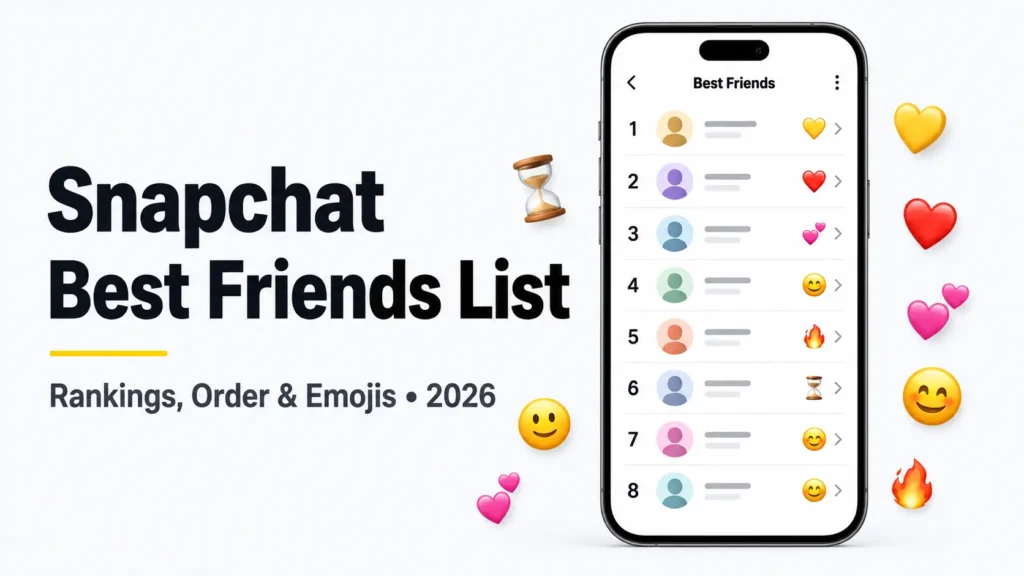
The Best Friends list is an automatic ranking of the people you interact with most on Snapchat. It shows up to eight friends based on your recent activity, refreshes continuously in the background, and cannot be edited by hand.
There’s no drag to reorder. No pin that changes the real math. No manual add or remove.
Three things trip people up constantly:
- It’s private. Only you see your own ranked list. Friends can’t view it, and you can’t view theirs.
- It’s personal to you. Your list is built from your behavior. Their list is built from theirs. The two don’t have to match.
- It’s live. It’s not a snapshot of your all-time closest friends. It’s a rolling reflection of the last two weeks.
The list shows up in three places:
| Location | What you see |
| Chat tab | Best Friends at the very top, before recent contacts, ranked in order |
| Send To screen | After taking a Snap, your Best Friends are the suggested recipients up top |
| Friendship Profile | Snapchat Plus only, showing the planet-based visual ranking |
A Quick History: Why This Feature Was So Controversial
Knowing where this feature came from explains why it works the way it does today.
Snapchat launched Best Friends in 2013, and back then it was public. Anyone visiting your profile could see your top friends. That sounds minor until you picture it playing out in real life: partners checking who ranked highest, friends noticing they’d dropped off, exes showing up where they shouldn’t.
The backlash was strong, and in 2015 Snapchat removed the feature entirely. It returned in 2018 rebuilt as a fully private feature, and that private version is what exists today.
This matters because it helps explain why the modern Best Friends list is private. Snapchat also provides separate privacy controls, such as Snapchat Ghost Mode for hiding your location on Snap Map. Keep that distinction in mind when we reach the relationship questions later: your Best Friends ranking and location visibility are separate features.
How the Best Friends Algorithm Works
Snapchat has never published the exact formula. But the list’s behavior over time makes the core logic clear, and years of consistent user observation confirm it.
The algorithm runs on a 14-day rolling window. Only your activity from the past two weeks counts toward your current rankings. Anything older carries almost no weight. This one fact explains nearly every “why did this change?” moment you’ll ever have.
Three principles govern how it behaves:
Recent behavior beats history. The list reflects who you’re talking to right now, not who you were close with six months ago. A friendship that was your whole world last spring but has gone quiet will fade, replaced by whoever currently has your attention.
Two-way interaction beats one-sided messaging. Mutual engagement, where both people send and receive regularly, carries far more weight than blasting snaps at someone who rarely replies. The algorithm is built to reward reciprocity.
You can’t force your way onto someone else’s list. Their rankings come from their behavior, not yours. No amount of effort on your end rewrites the math on theirs.
That third point is the one people most need to hear, and it’s the key to reading the emojis honestly.
What Does the Order of Best Friends on Snapchat Mean?
This is one of the most searched questions about the feature, and the answer is refreshingly direct. The order is a strict ranking of interaction, from most to least, based on your last 14 days.
Reading top to bottom:
- Position 1 is the person you’ve had the most two-way snap and chat activity with recently. This is your current number one Best Friend.
- Positions 2 through 8 descend in order of interaction volume, weighted toward direct snaps and mutual exchange.
- The person at the very top of your Chat tab is your live number one at this exact moment.
A few things the order does not mean:
The order does not rank how much you care about someone. It ranks how much you’ve interacted. A close friend you text on another app might not appear at all.
The order is not how the other person’s list is arranged. You could be their number one while they’re your number five, or the reverse.
The order is not permanent. Because it’s built on a 14-day window, position 1 today can be position 4 next week with no drama behind it. Just a shift in who you snapped.
Here’s how positions usually map to behavior:
| Position | What it usually reflects |
| 1 | Highest mutual snap and chat volume in the last 14 days, often a streak partner |
| 2 to 3 | Strong, consistent daily interaction, just below your top exchange |
| 4 to 6 | Regular but less frequent contact, or heavy chat with fewer snaps |
| 7 to 8 | The edge of your top eight, the most volatile spots, easily displaced |
The bottom positions change most often. If someone hovers at 7 and 8 and keeps swapping places every few days, that’s completely normal. Those spots sit right at the threshold where small changes tip the balance.
What Affects Your Ranking, Ranked by Weight
Not all interactions are equal. Here’s how the actions stack up, from most influential to least:
| Factor | Impact on ranking |
| Direct photo and video snaps, sent and received | Highest |
| Text chats back and forth | High |
| Response speed | Medium |
| Snapstreaks, daily consistency | Medium |
| Story replies, not views | Low |
| Group chat messages | Lower than direct messages |
A few clarifications most guides skip:
Direct snaps are king by a clear margin. Actual photos and videos taken through the camera and sent one to one carry the most weight of anything. If you want to influence your list, this is the lever with the longest arm.
Chats count, but sit just below snaps. Text conversations are meaningful, and the algorithm treats them that way, just not quite as heavily as camera snaps.
Speed and consistency are multipliers, not the main event. Replying fast and keeping a streak alive both help, but they amplify the effect of snaps and chats rather than replacing them.
Group messages help less than direct ones. Activity in a group registers, but one to one contact moves the needle far more.
What Does NOT Affect Your Best Friends List
This is where most users are simply wrong. None of the following count toward your ranking:
- Watching someone’s Story
- Visiting or opening their profile
- Searching their username
- Voice calls and video calls
- Snap Score
- How long you’ve been friends on the app
- Following or being followed
Two of these deserve special attention.
Story views are one of the biggest misconceptions. Watching someone’s Story does not automatically move them up your Best Friends ranking. The eyes indicator on a Snapchat Story is also associated with Snapchat+ Story Rewatch information, not Best Friends ranking. You can watch someone’s Story regularly without giving them a higher position on your list.
Voice and video calls don’t count either. This surprises people, because calls feel like the most intimate form of contact. But the algorithm is built around snaps and chats, and calls sit outside that math no matter how often you use them.
Here’s the insight that ties it together. The ranking primarily reflects direct Snapchat interaction rather than every profile indicator you see. For example, the green dot on Snapchat is an activity indicator; it does not increase someone’s Best Friends position. Once you separate profile activity from direct interaction, changes to the list become easier to understand.
Every Best Friends Emoji Explained
The emojis next to names are visual shorthand for your interaction patterns. The following table covers the symbols connected with Best Friends, while our complete guide to Snapchat emoji meanings explains the other hearts, icons and status indicators used throughout the app.
| Emoji | Name | Meaning |
| 💛 | Yellow Heart | You’re each other’s number one Best Friend right now |
| ❤️ | Red Heart | You’ve been each other’s number one for two straight weeks |
| 💕 | Pink Hearts | You’ve been each other’s number one for two straight months |
| 😊 | Smiling Face | They’re in your top eight, may not be mutual |
| 😎 | Sunglasses Face | You share a number one Best Friend with this person |
| 😬 | Grimacing Face | Your number one Best Friend is also their number one |
| 😏 | Smirking Face | You are one of their Best Friends, but they’re not one of yours |
| 🔥 | Fire | Active Snapstreak, with the day count beside it |
| ⌛ | Hourglass | Your Snapstreak is about to expire, send a snap soon |
| 💯 | Hundred | You’ve hit a 100-day Snapstreak |
| 🎂 | Birthday Cake | It’s this friend’s birthday today |
| ⭐ | Gold Star | Someone replayed this person’s Snap in the last 24 hours |
The most important thing to understand: two people looking at the same conversation can see completely different emojis. The emoji on your side reflects your interaction pattern, not theirs. This one fact clears up a huge amount of confusion, and the next two sections unpack it fully.
Is 😊 Mutual on Snapchat?
No. The smiling face is not necessarily mutual. This is one of the most misunderstood emojis on the platform, so let’s be precise.
The smiling face means that person is in your top eight. That’s the whole meaning. It’s a statement about your behavior toward them, based on your last 14 days. It says nothing about whether you appear in their top eight.
So you can have a 😊 next to someone who does not have a 😊 next to your name on their phone. From your side, they made your list. From their side, you might not have made theirs.
Here’s how to tell what’s actually going on:
- If you see 😊 next to someone, it means they’re in your top eight. One-directional.
- If they see 😏 next to your name, it means you have them as a Best Friend but they don’t have you. That’s the flip side.
- The only emojis that guarantee it’s mutual are the hearts, because those require both people to rank each other as number one at the same time.
Bottom line: a smiling face is a one-way signal. It confirms your feelings about the friendship, not theirs. If you want to know whether it’s mutual, the emoji alone can’t tell you, and by design Snapchat won’t show you their list to check.
Is 💛 Better Than 💕 on Snapchat?
Short answer: pink hearts represent a longer, more established connection than the yellow heart. But “better” depends on what you mean, so let’s break it down properly, because this is genuinely nuanced.
The three hearts form a progression, and each one is a longevity badge on top of the same status, being each other’s number one Best Friend:
| Emoji | What it requires | What it signals |
| 💛 Yellow Heart | Each other’s number one right now | A fresh mutual number one status |
| ❤️ Red Heart | Each other’s number one for 2 straight weeks | A sustained mutual number one |
| 💕 Pink Hearts | Each other’s number one for 2 straight months | A long-running, consistent mutual number one |
So in terms of duration and consistency, the ranking is pink, then red, then yellow. Pink hearts are hardest to earn because they need two straight months of both of you keeping each other at the top. That’s real daily, mutual, back-and-forth snapping.
But here’s the framing most guides miss:
The yellow heart is not a lesser version of the pink hearts. It’s the entry point to the same relationship, the moment you two first become mutual number ones. Every pink-heart pair started as a yellow-heart pair.
All three hearts share the same core meaning. You are each other’s number one, mutually, at the same time. The color just tells you how long it’s lasted.
Losing a pink heart back to a yellow heart doesn’t mean the friendship broke. It means the two-month streak reset, usually because one of you had a quieter stretch. The connection is intact. The timer restarted.
So is yellow better than pink? If you’re asking which shows a deeper track record, pink is the more advanced badge. If you’re asking which shows a stronger current bond, they’re identical in the present tense. Both mean you’re each other’s number one today. The yellow heart just hasn’t had time to age into pink yet.
One-Sided vs Mutual Best Friends
You can be someone’s Best Friend without them being yours, and this is completely normal. Not a sign anything is wrong. The algorithm ranks each person’s list independently, from their own behavior alone.
Picture a common scenario. You snap one person constantly, but they spread their activity across a wide circle. You might rank them as your number one while you sit at position 6 on their list. Neither of you is doing anything wrong. You simply have different patterns.
Here’s how to read the direction of a friendship:
| What you see | What it tells you |
| 😊 Smiling face | They’re in your top eight |
| 😏 Smirking face | You’re in their top eight, but they’re not in yours |
| 💛 ❤️ 💕 Any heart | Fully mutual number one status, both directions confirmed |
The hearts are the only guarantee of two-way status. Everything else is a one-directional signal about a single person’s behavior. This is by design, and it’s the whole reason the system survived after the 2015 controversy.
How Often Does the Best Friends List Update?
The list updates automatically, usually showing visible movement within 24 to 48 hours of a change in your behavior.
Here are realistic timelines for the changes people most want:
Small shifts take 24 to 48 hours. Snapping one person slightly more for a few days moves the lower positions.
Moving someone to number one takes 7 to 14 days. Taking someone from the bottom of your top eight to the very top needs one to two weeks of consistent, heavy, mutual activity.
Pushing someone off the list takes 5 to 7 days. Reduce interaction with them while increasing it with others, and they usually drop out of the top eight within a week.
Two clarifications matter here:
Clearing a conversation does not remove someone. Deleting the chat thread doesn’t reset the ranking. Only reduced interaction over time moves someone down.
One huge session won’t override the pattern. A single marathon snapping day helps less than steady daily contact spread across the two-week window. The algorithm rewards consistency, not spikes.
How to Move Someone Up or Down
There’s no manual editing. But you have real, reliable influence through your behavior, and the results show up predictably inside the 14-day window.
To move someone up the list:
- Send them direct snaps daily, actual camera photos and videos, since these carry the most weight
- Reply quickly to keep response speed working in your favor
- Start and maintain a snapstreak to build daily consistency
- Keep it up for 7 to 14 days to reach the top spot, a few days is enough to climb lower positions
To move someone down the list:
- Reduce your direct snaps to that person
- Increase activity with others so newer interactions take priority
- Give it 5 to 7 days, and their position falls naturally as fresher activity outranks them
One warning worth stating clearly. No third-party app can legitimately change your rankings. Any app claiming to reorder your list, reveal other people’s lists, or hack the algorithm either does nothing at all or violates Snapchat’s terms of service and puts your account at real risk. The only genuine method is your own behavior.
What Happens When You Remove a Friend
Removing someone has immediate effects that go well beyond the Best Friends ranking:
- Their friendship emoji disappears instantly
- Your Snapstreak with them ends immediately, no grace period
- They lose access to your private Stories
- If you re-add them later, the ranking history does not carry over, everything restarts from zero, including any streak
Here’s the practical advice most people need. If your goal is just to lower where someone ranks, don’t remove them. Removing is a heavy, permanent-feeling action that burns the streak and cuts off Story access. Simply reducing your interaction over about a week achieves the same drop without any of that damage. Save the actual removal for when you genuinely want to end the connection.
Snapchat Plus and the Best Friends List
Snapchat Plus does not let you manually control how the algorithm ranks your friends. Premium subscribers receive additional tools and ranking visibility, but ordinary interaction patterns still determine the underlying Best Friends order.
| Feature | Free | Snapchat Plus |
| Best Friends shown | Up to 8 | Up to 16 |
| Planet System visual | No | Yes |
| Pin number one Best Friend | No | Yes |
| Full Friendship Profile | No | Yes |
What each addition actually does:
Extended Best Friends List shows up to 16. Same ranking logic, just extended further down. You see positions 9 through 16 that free users can’t.
The Planet System assigns each of your top eight a planet, with Mercury as your number one and Neptune as your eighth. For example, the Saturn Snapchat planet represents position six. It’s a visual version of the same ranking: the closer the planet is to the sun, the higher the friendship position.
Pin your number one lets you manually display one person as your number one on your profile. This is cosmetic. It does not change the underlying algorithm. The pin is a display choice, not a ranking override.
Full Friendship Profile is the detailed view that houses the planet visual and interaction history.
Here’s a point worth clearing up. The Planet System is often confused with the Best Friends list itself. They’re not different rankings. The planets are simply a visualization of the exact same top-eight ranking, dressed up as a solar system. If you understand the Best Friends order, you already understand the planets. Mercury through Neptune map onto positions 1 through 8.
How to Customize Your Friend Emojis
Snapchat lets you swap the default friendship emojis for any emoji you prefer. This is purely visual and has zero effect on rankings.
To customize them:
- Open Snapchat and tap your profile icon
- Tap the Settings gear in the top right
- Scroll to Customize Emojis under the Friends section
- Select a friendship tier and replace its emoji from the picker
Two things to know:
Changes apply on your side only. The person on the other end sees whatever their settings or defaults show. You’re customizing your own view, not theirs.
This is free for everyone. You don’t need Snapchat Plus to customize emojis.
Reading the List in Relationships: What It Can and Can’t Tell You
This is the section most guides avoid, even though it’s what a huge share of people are actually searching for. These questions are common, emotional, and deserve honest, grounded answers instead of either fearmongering or dismissal.
Let’s take them in turn.
“How do I know if my partner is Snapchatting someone else?”
First, the honest truth. Snapchat’s Best Friends system was deliberately designed so you cannot surveil someone else’s list. You cannot see your partner’s Best Friends, their emojis, their planets, or their rankings from your own account. That privacy is a feature, built specifically in response to the relationship conflicts the old public list caused back in 2013 to 2015.
What the system can legitimately tell you is limited and indirect. On their phone, if you’re looking together and openly, a 🔥 fire emoji with a high day count next to an unfamiliar name shows frequent daily snapping with that person. A heart next to someone other than you would show that person is their mutual number one. A 😊 smiling face means that person is in their top eight.
But here’s the crucial framing. An emoji is not evidence of anything except snap frequency. A high streak could be a sibling, a coworker, a group-project partner, a childhood friend, or a gaming buddy. The algorithm measures volume of interaction, not the nature of a relationship. Reading romantic meaning into a fire emoji is exactly the kind of misinterpretation the feature’s own history warns against.
“How do I catch a cheating partner on Snapchat?”
The most important thing to say here is this. There is no legitimate app, trick, or method that lets you secretly monitor someone else’s Snapchat activity. Every service advertising this is a scam, malware, or a terms-of-service violation that can compromise your own account. In many places, covertly monitoring another adult’s private communications can carry legal consequences too.
More fundamentally, the Best Friends list is the wrong tool for this question. It can’t tell a partner from a plumber. Trying to build a case out of emoji positions tends to produce anxiety and false certainty at the same time, because you’re reading a frequency metric as if it were a relationship map.
If you’re at the point of wanting to catch a partner, the real issue is trust, and no algorithm can resolve that. The genuinely useful move, however much harder it is, is a direct, honest conversation about what you’re feeling and why. No emoji will give you the answer you’re looking for, and treating the app as a surveillance tool usually damages the relationship faster than whatever you feared.
“How do I know if he’s seeing someone else?”
Same principle, stated plainly. Snapchat’s rankings can’t answer a question about someone’s intentions, feelings, or fidelity. They measure who a person exchanged camera snaps with over 14 days, nothing more. A name climbing someone’s list tells you they’ve been snapping that person a lot recently. It does not tell you why, and it definitely doesn’t tell you what’s in their heart.
If this worry is sitting with you, the healthiest path is the direct one. Concerns about a relationship are real and worth taking seriously, but they’re worth taking to the person, not to an app’s ranking system that was never built to carry that weight. If the anxiety is persistent and hard to shake, talking it through with someone you trust, or a counselor, tends to help far more than decoding emojis ever will.
The honest summary: the Best Friends list is a frequency meter, not a loyalty detector. It was made private precisely so it couldn’t be weaponized inside relationships. Use it to understand your own social patterns. Don’t ask it questions it was never built to answer.
Myths vs Reality
| Myth | Reality |
| Once on your list, always on your list | Rankings change constantly within the 14-day window |
| Story views boost your ranking | Story views have zero effect |
| One big snap session changes everything | Consistent daily activity over days is what moves rankings |
| Others can see your Best Friends list | Fully private, only you see it |
| Snap Score affects ranking | Snap Score is completely irrelevant |
| Third-party apps can change your ranking | No legitimate method exists, these apps risk your account |
| Voice and video calls count | Calls are not factored in |
| Clearing a chat removes someone | Only reduced interaction over time removes them |
| The smiling face is always mutual | It’s one-directional, only means they’re in your top eight |
| Pink hearts mean a stronger bond than yellow right now | Both mean mutual number one today, pink just means it lasted two months |
| Snapchat Plus lets you manipulate rankings | Plus adds visibility and tools, not algorithmic control |
| You can spy on a partner’s list | Impossible by design, you can’t see anyone else’s list |
Frequently Asked Questions
How many Best Friends can you have on Snapchat? Up to eight on the free version. Snapchat Plus subscribers get an Extended Best Friends List showing up to 16, ranked with the same algorithm.
Can my friends see my Best Friends list? No. The list is fully private. Only you see your own ranked order, and you can’t see anyone else’s.
What does the order of Best Friends mean? It’s a strict ranking of your interaction over the last 14 days, from most to least. Position 1 is whoever you’ve had the most mutual snap and chat activity with recently.
Is the smiling face mutual? No. It only means that person is in your top eight. They may or may not have you in theirs. Only the hearts guarantee mutual status.
Is 💛 better than 💕? They both mean you’re each other’s current number one Best Friend. Pink hearts additionally show you’ve held that status for two straight months, so it’s the more advanced longevity badge. The present-tense bond is identical.
How do I make someone my number one Best Friend quickly? Send them direct snaps daily, reply fast, and keep a streak going. Reaching number one usually takes 7 to 14 days of consistent, heavy, mutual activity.
Do chats or snaps matter more for ranking? Direct snaps carry the most weight by a clear margin. Chats count too, but sit just below snaps.
Why did someone disappear from my Best Friends list? Your interaction with them dropped over the last two weeks while you snapped others more, so newer activity pushed them out. It usually takes 5 to 7 days of reduced contact.
Is the Best Friends list the same as Snapchat Planets? No, but they’re closely linked. Planets are a Snapchat Plus visualization of the same top-eight ranking, with Mercury as number one through Neptune as number eight.
How do I see where I am on someone else’s Best Friends list? You can’t directly, their list is private. The closest hint is the emoji on your side. A smirking face means you’re in their top eight but they’re not in yours.
How often does the Best Friends list update? Automatically, usually within 24 to 48 hours of a behavior change. Bigger reshuffles like reaching number one take 7 to 14 days.
What does the grimacing face mean? Your number one Best Friend is also their number one Best Friend. You’re both snapping the same person the most.
Can I hide my Best Friends list from others? It’s already hidden. No one but you can see it, so there’s nothing extra to hide.
Can I catch a partner cheating using the Best Friends list? No. The list measures snap frequency, not the nature of a relationship, and you can’t view anyone else’s list anyway. It can’t tell a partner from a coworker, and no legitimate app lets you monitor someone else’s Snapchat. Concerns about a relationship are best handled through direct conversation.
Final Takeaway
The Best Friends list is a direct mirror of your last 14 days on Snapchat. Nothing more, and nothing less. Rankings shift faster than most people expect because the algorithm is built to reflect who you’re actually talking to right now, not who you were close with months ago.
Once you understand the three things that really drive it, recent activity, direct snaps, and two-way engagement, every change becomes readable. The emojis stop feeling mysterious. The order stops feeling random. And the questions that used to cause anxiety, especially in relationships, get a clear answer. The list is a frequency meter, private by design, that tells you about your patterns and no one else’s intentions.
Use it as the small, useful social tool it was meant to be. It reflects your connections. It doesn’t define them.