17 Common Things That Are 6 Inches Long (Everyday Examples)
Six inches is exactly half a foot, or 15.24 centimeters. Common things that are 6 inches long or close to it include a U.S. dollar bill, a medium banana, a six-inch sandwich, a small ruler, a hair comb, and certain smartphones. These familiar objects make it easier to visualize the measurement when you do not have a measuring tape nearby.
Some objects provide a much more accurate reference than others because everyday products vary in size. Below, you will find 17 practical comparisons, exact conversions, and simple ways to estimate six inches at home. For more helpful measurement guides and everyday size comparisons, visit Snap Planets.
Key Takeaways
- Six inches equals exactly 15.24 centimeters, 152.4 millimeters, or 0.5 feet.
- A U.S. dollar bill measures approximately 6.14 inches long, making it one of the most convenient everyday references.
- A six-inch sandwich and a ruler with a six-inch scale provide straightforward ways to picture this length.
- Bananas, smartphones, combs, utensils, and other household objects can be close to six inches, but their dimensions vary.
- For accurate cutting, fitting, or construction, use a measuring tool rather than relying on an estimated object size.
17 Everyday Things That Are 6 Inches Long or Close to It
Six inches is roughly the length of several objects you probably handle every day. However, it is important to distinguish objects with established dimensions from items that happen to measure about six inches in certain sizes or models.
The following table summarizes 17 useful examples, along with the specific dimension you should compare.
| Everyday Object | Length Reference | Accuracy as a 6-Inch Comparison |
|---|---|---|
| 1. Six-inch ruler | 6-inch measurement scale | Exact when properly marked |
| 2. U.S. dollar bill | 6.14 inches along the long edge | Very close |
| 3. Six-inch sandwich | Nominal 6-inch portion | Approximate |
| 4. Medium banana | Often around 6 to 8 inches | Varies by fruit |
| 5. Small cucumber | Some varieties around 6 inches | Varies by variety |
| 6. Medium carrot | Some carrots around 6 inches | Approximate |
| 7. Dessert spoon | Some designs around 6 inches overall | Varies by design |
| 8. Dessert fork | Some designs around 6 inches overall | Varies by design |
| 9. Used wooden pencil | Can reach 6 inches after sharpening | Depends on wear |
| 10. Ballpoint pen | Some models around 5.5 to 6 inches | Model-dependent |
| 11. Small notepad | 6-inch side of a 4-by-6-inch pad | Exact nominal size |
| 12. Index card | 6-inch side of a 4-by-6-inch card | Exact nominal size |
| 13. Hair comb | Some everyday combs around 6 inches | Varies by type |
| 14. Eyeglasses case | Some compact cases around 6 inches | Varies by case |
| 15. Makeup brush | Some brushes around 6 inches overall | Varies by brush |
| 16. Smartphone | Some phones around 6 inches tall | Model-dependent |
| 17. Compact TV remote | Some remotes around 6 inches long | Model-dependent |
The most reliable choices are the marked ruler, the dollar bill, and properly sized stationery. Natural foods and manufactured accessories can still help you make a quick estimate, but they should not be treated as exact measuring instruments.
1. Six-Inch Ruler
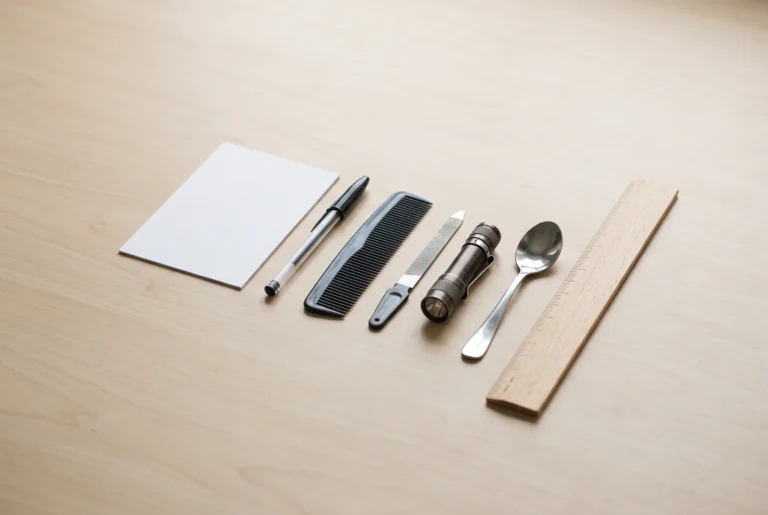
A six-inch ruler is the simplest physical example because its scale is designed to measure exactly six inches. Small rulers are commonly used for school assignments, crafts, drawing, and desk work.
When using one, measure from the zero mark rather than assuming the outer edge of the ruler is the starting point. Some rulers leave extra material beyond their printed measurement scales.
2. U.S. Dollar Bill
A modern U.S. dollar bill is approximately 6.14 inches long and 2.61 inches wide. Its long edge is only about 0.14 inches longer than six inches, making it a particularly useful everyday reference.
The difference is approximately 3.6 millimeters. For a rough visual comparison, the bill is close enough to help estimate six inches without requiring a separate measuring tool.
Because modern U.S. banknotes share the same physical dimensions across denominations, you can use a $1, $5, $10, or other current U.S. bill for the same comparison.
3. Six-Inch Sandwich
A sandwich sold as a six-inch portion gives you a recognizable picture of this length. The name generally describes the intended portion size rather than guaranteeing that every prepared sandwich will measure exactly six inches.
Bread can differ slightly in shape, size, and how it is cut. Nevertheless, picturing a six-inch sub sandwich is an easy way to understand the measurement.
4. Medium Banana
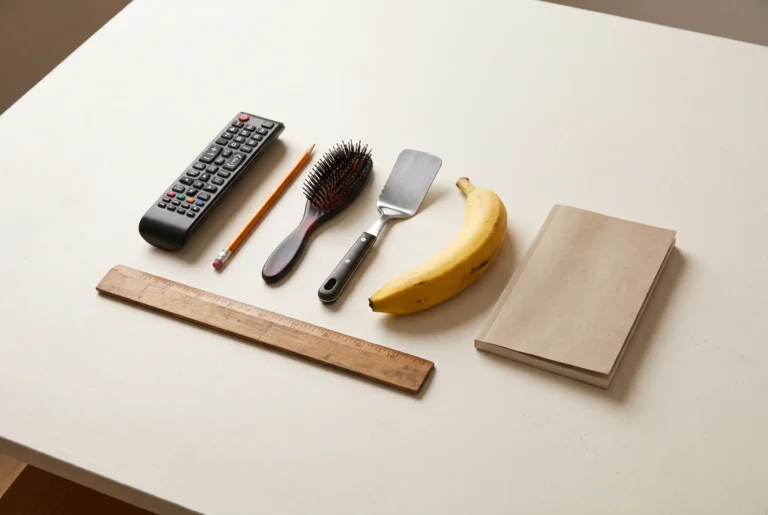
A banana can provide a convenient approximate length reference, especially when selecting one that measures around six inches. The fruit’s size depends on the variety and individual banana.
USDA food-size classifications include medium bananas measuring approximately 7 to 7.875 inches, so a typical medium banana may actually be longer than six inches. A smaller banana can provide a closer comparison.
Remember that a banana is curved. Its straight-line length from end to end differs from the distance measured along the curve.
5. Small Cucumber
Some small cucumbers measure approximately six inches from end to end. Certain pickling and compact cucumber varieties can provide a familiar visual comparison.
However, cucumber lengths vary considerably. Mini cucumbers may be shorter, while full-size slicing cucumbers are often longer. Choose an appropriately sized cucumber rather than assuming every one measures six inches.
6. Medium Carrot
A carrot measuring around six inches is another useful kitchen example. Whole carrots come in many lengths, and a relatively short or medium-sized specimen may be close to the target measurement.
Measure from the top of the edible root to its narrow tip, excluding leafy greens. A carrot is most helpful for an approximate comparison because its length and shape are not standardized.
7. Dessert Spoon
Some dessert spoons are around six inches long when measured from the end of the handle to the tip of the bowl. They are often smaller than full-size tablespoons or serving spoons.
Flatware designs differ among manufacturers, and there is no universal six-inch length for every dessert spoon. If you own a set close to this measurement, the spoon can become a convenient reference for future estimates.
8. Dessert Fork
Some compact dessert forks measure approximately six inches from the tips of the tines to the end of the handle. They are generally smaller than larger dinner forks.
The exact size depends on the flatware collection. Dessert forks that measure closer to seven inches also exist, so checking your specific fork once is more useful than relying on its name.
9. Used Wooden Pencil
A traditional wooden pencil can become approximately six inches long after repeated sharpening. A new pencil is generally longer, often around seven inches or more.
For a quick estimate, place the used pencil next to the object you want to compare. Because sharpening gradually shortens a pencil, this reference only works reliably after you know its actual length.
10. Ballpoint Pen
Many everyday ballpoint pens are approximately 5.5 to 6 inches long, although different models can be shorter or longer. A pen near the upper end of that range gives a reasonable six-inch comparison.
Measure from the writing end to the opposite end, including the cap if it is attached. Retractable pens and capped pens may have different overall lengths.
11. Small Notepad
A notepad labeled 4 by 6 inches has a six-inch side that makes it especially useful as a reference. Unlike an arbitrary pocket notebook, the labeled paper dimensions give you a defined measurement.
You can use the longer side to estimate six inches and the shorter side to estimate four inches. Check whether the stated dimensions describe the paper itself or the outer cover.
12. Four-by-Six-Inch Index Card
A standard 4-by-6-inch index card provides a straightforward six-inch reference along its longer edge. This makes it one of the easiest objects to use when measuring small items at a desk.
Index cards are lightweight, inexpensive, and available in common standardized sizes. An undamaged card with accurate nominal dimensions is more dependable than a random household object.
13. Hair Comb
Many small or medium personal hair combs measure around six inches long. They are designed to be easy to hold, carry, and store.
Travel combs may be considerably shorter, while styling and barber combs are frequently longer. If your comb measures six inches, it makes a reusable reference that fits easily in a drawer or toiletry bag.
14. Eyeglasses Case
A compact eyeglasses case may measure roughly six inches along its longest side. The dimensions depend on the shape of the frames and the case’s protective design.
Some hard-shell cases are longer to accommodate large sunglasses or wide frames. Measure the exterior length if you intend to use a particular case as a reference.
15. Makeup Brush
Some full-size makeup brushes measure around six inches from the handle end to the tip of the bristles. Powder, blush, foundation, and eye brushes come in different lengths.
A brush near six inches can help illustrate the measurement, but it should not be assumed that all makeup brushes share that length. Include the bristles when comparing overall dimensions.
16. Smartphone
Many smartphones have physical heights close to six inches. For example, Apple’s iPhone 15 is approximately 5.81 inches tall, making it slightly shorter than six inches.
Be careful not to confuse screen size with phone height. Smartphone screens are measured diagonally, so a phone advertised with a 6.1-inch display does not necessarily have a body that measures 6.1 inches tall.
Use the manufacturer’s actual height specification if you need a dependable measurement.
17. Compact TV Remote
Some compact television and streaming-device remotes are approximately six inches long. They are common household objects that can provide an easy visual comparison.
Remote controls vary significantly by manufacturer and model. Some are much shorter than six inches, while larger universal remotes can be considerably longer. Check the length before depending on one as a measurement reference.
How Long Is 6 Inches in Other Units?
Six inches equals exactly 15.24 centimeters. In the U.S. customary system, it is half a foot and one-sixth of a yard.
Here are the conversions for common units of length:
| Measurement Unit | Equivalent to 6 Inches |
|---|---|
| Inches | 6 in |
| Feet | 0.5 ft |
| Yards | 0.1667 yd (approximately) |
| Centimeters | 15.24 cm |
| Millimeters | 152.4 mm |
| Meters | 0.1524 m |
| Micrometers | 152,400 µm |
These conversions follow from the international definition of one inch as exactly 2.54 centimeters.
To convert inches into centimeters, multiply by 2.54:
6 × 2.54 = 15.24 centimeters
To convert centimeters back into inches, divide the centimeter measurement by 2.54. For instance, 15.24 divided by 2.54 gives exactly 6.
For most household projects, rounding six inches to approximately 15 centimeters is acceptable for visualization. However, the precise difference between 15 centimeters and six inches is 2.4 millimeters, which can matter for fitting parts or cutting material.
How to Measure 6 Inches Without a Ruler
If you do not have a ruler or tape measure, a known-size household object can help you estimate six inches. The best method depends on how precise you need to be.
Method 1: Use a U.S. Dollar Bill
A U.S. dollar bill is one of the most convenient references because its size is standardized.
- Place the bill flat on a surface.
- Align one end of its long edge with the starting point of what you want to measure.
- Compare the object’s length with the bill.
- Remember that the bill extends about 0.14 inches beyond the six-inch mark.
This method works well for approximate comparisons of small books, kitchen utensils, packaging, and other everyday objects.
Method 2: Fold a Standard Letter-Size Sheet of Paper
In the United States, standard letter paper measures 8.5 by 11 inches. Although neither full side measures six inches, you can create a useful reference from its dimensions.
For a straightforward approximation, measure halfway along the paper’s 11-inch side to get 5.5 inches. This gives a point half an inch short of six inches.
If you need exactly six inches and already have a printed inch scale or a known measurement reference, mark the precise distance on the paper and save it as a reusable guide.
Do not assume that folding ordinary letter paper in half produces six inches. Folding its 11-inch side in half produces 5.5 inches, while folding its 8.5-inch side produces 4.25 inches.
Method 3: Use a 4-by-6-Inch Index Card
Place the long edge of a 4-by-6-inch index card beside the item you want to measure. Align the ends and compare the lengths.
This is a particularly practical method for paper crafts, scrapbooking, labeling, and organizing small objects.
Method 4: Use a Phone With Known Dimensions
Look up the physical height of your phone in its manufacturer’s specifications. If the height is close to six inches, use that dimension as an approximate guide.
For example, a phone that measures 5.8 inches tall is 0.2 inches shorter than six inches. Knowing the difference makes your estimate more meaningful.
Method 5: Make a Reusable Six-Inch Reference
If you frequently need to estimate this length, create a small reference card or strip of cardboard.
- Use an accurate ruler or measuring tape once.
- Mark two points exactly six inches apart on stiff paper or cardboard.
- Draw a straight line between the marks.
- Label the reference and keep it in your desk, toolbox, or craft supplies.
This is more reliable than repeatedly guessing with differently sized everyday items.
What Does 6 Inches Look Like Compared With Other Lengths?
Understanding nearby measurements makes six inches easier to visualize. A six-inch object is twice as long as a three-inch object, half as long as a 12-inch ruler, and three-quarters as long as an eight-inch object.
| Length | Centimeters | Comparison With 6 Inches |
|---|---|---|
| 3 inches | 7.62 cm | Half as long |
| 4 inches | 10.16 cm | 2 inches shorter |
| 5 inches | 12.70 cm | 1 inch shorter |
| 6 inches | 15.24 cm | Reference length |
| 7 inches | 17.78 cm | 1 inch longer |
| 8 inches | 20.32 cm | 2 inches longer |
| 12 inches | 30.48 cm | Twice as long |
| 18 inches | 45.72 cm | Three times as long |
One simple way to picture the measurement is to imagine a standard 12-inch ruler divided into two equal parts. Each half represents six inches.
Similarly, two objects that are each exactly three inches long would measure six inches if placed end to end without a gap or overlap.
When Is a 6-Inch Measurement Useful?
Six inches appears frequently in everyday tasks because it is a manageable distance for small items, decorations, tools, and household layouts. Knowing the measurement can help with several practical situations.
Home Organization
When arranging storage containers or accessories, estimating six inches helps determine whether small items might fit in a drawer or shelf compartment.
However, always check all three dimensions, length, width, and height, before buying storage products. An object that is six inches long may still be too wide or tall for the available space.
Crafting and DIY Projects
Six-inch lengths are useful for preparing decorative strips, paper elements, small signs, and craft components.
A marked ruler is best when multiple pieces must be identical. Even small errors can accumulate when cutting several pieces from the same material.
Cooking and Food Preparation
Kitchen utensils, produce, and serving portions can all be compared using six inches as a familiar reference.
In baking, however, a six-inch cake pan usually refers to the pan’s diameter, not its height or circumference. Understanding which dimension is being described helps prevent mistakes.
Online Shopping
Product listings often include dimensions in inches. Comparing a six-inch product with a familiar physical object can help you judge its scale before ordering.
For example, a decorative item listed as six inches tall may be approximately the height of a compact smartphone. This is a useful mental comparison, even though the exact phone size may differ.
Understanding Length, Width, Height, and Diameter
An object can be six inches in one dimension without being six inches in another. Understanding how measurements are described is essential when using real-life examples.
- Length: Usually the distance from one end of an object to the other along its longest dimension.
- Width: The measurement across an object from one side to the other, usually perpendicular to its length.
- Height: The vertical distance from the bottom of an upright object to its top.
- Diameter: The straight-line distance across a circle through its center.
- Thickness or depth: An additional dimension describing how thick an object is or how far it extends backward.
For example, a smartphone might be six inches tall but only about three inches wide. A six-inch pizza, by contrast, measures six inches across its diameter.
These objects share one six-inch measurement, but their overall sizes and shapes are very different.
Why Six Inches in Diameter Is Different From Six Inches in Circumference
For circular objects, confusing diameter with circumference creates a major measurement error.
Diameter measures straight across the center, while circumference measures the distance around the outer edge.
The circumference of a circle is calculated by multiplying its diameter by pi (approximately 3.14159).
A circle with a six-inch diameter therefore has a circumference of approximately 18.85 inches.
This distinction matters when measuring cake pans, flowerpots, round containers, and other circular household items.
Can You Estimate 6 Inches With Your Hand?
Yes, your hand can provide an approximate six-inch reference, but human hand dimensions differ significantly. A finger, palm, or hand span should never be treated as a universal measurement.
Some adults can approximate six inches using a portion of their hand. Others may need a different landmark because their hands are larger or smaller.
Using Your Palm or Hand
Measure a convenient distance on your hand with a ruler, such as the distance from a wrist crease to a fingertip or between two easily recognized points.
Once you know that measurement, you can use your hand as a personal reference for quick estimates.
The key is calibration. An individual’s measured hand can be useful, whereas assuming that everyone’s hand measures six inches is unreliable.
Using Finger Widths
You can also estimate lengths by comparing them with the widths of your fingers. However, finger widths vary by person and by which finger is used.
For greater consistency, measure the width of one or two fingers and calculate how many of those widths equal approximately six inches.
This technique may help with informal spacing, but it is unsuitable for precision work.
How Accurate Are Household Objects for Measuring Six Inches?
Not every object described as six inches long is actually six inches. Some are manufactured to known dimensions, while others vary naturally or between product models.
Choosing the right reference depends on how much error your task allows.
| Reference Type | Example | Best Use |
|---|---|---|
| Calibrated measuring tool | Marked six-inch ruler | Accurate everyday measurement |
| Known fixed dimensions | 4-by-6-inch index card | Quick comparisons and crafts |
| Standardized object | U.S. dollar bill | Close visual estimation |
| Model-dependent object | Smartphone or pen | Approximation after checking specifications |
| Naturally variable object | Banana or carrot | Informal visualization only |
| Body-based estimate | Hand or finger spacing | Personal estimates after calibration |
If you are estimating whether a decorative object will fit on a shelf, a small difference may not matter. If you are drilling holes, cutting wood, or checking the clearance of a fitted component, the same difference could cause problems.
The more precise the task, the more important it is to use an appropriate measuring tool.
Common Mistakes When Visualizing Six Inches
Even a familiar length can be misunderstood if you compare the wrong dimension or assume an object has a standard size.
Confusing Screen Size With Device Height
A smartphone with a six-inch screen does not necessarily measure six inches from top to bottom. Display sizes usually describe diagonal measurements.
Always compare the device’s actual height when using it to estimate a vertical length.
Assuming All Objects in a Category Are Identical
Not every banana, fork, pen, or eyeglasses case measures six inches. Natural variation and different manufacturing designs make these objects unreliable as precise standards.
Checking your specific object’s dimensions once can turn it into a more useful reference.
Measuring From the Wrong Starting Point
Some rulers have a small margin before the zero mark. Starting from the physical edge rather than the marked zero can introduce an error.
For dependable results, align the start of the object with the actual zero mark.
Measuring a Curved Object Along the Wrong Path
A curved banana or bent piece of material may have a different end-to-end length than its length along the curve.
Choose the correct measurement based on your purpose. A straight-line distance is different from measuring along an object’s surface.
Rounding Too Early
Six inches is 15.24 centimeters, not exactly 15 centimeters. Rounding can be helpful for mental estimates but may create errors in detailed work.
Keep the exact conversion when working with precise dimensions.
When Should You Use a Ruler Instead of an Everyday Object?
An everyday object is useful when you only need to understand the approximate scale of something. A ruler or measuring tape is the better choice whenever accuracy affects the result.
Use an actual measuring tool for tasks such as:
- Cutting wood, metal, or plastic to a required length.
- Checking whether furniture or equipment will fit into an available space.
- Marking drilling positions or hardware locations.
- Measuring precise sewing patterns or craft templates.
- Confirming product dimensions before ordering replacement parts.
- Checking gaps and clearances where small differences matter.
For longer distances, a tape measure is generally more convenient than a short ruler. For small components requiring tighter tolerances, a suitable caliper may provide more useful precision.
At much larger scales, such as estimating the size of a room or vehicle, measuring in feet rather than inches is often easier to understand.
The Easiest Way to Picture 6 Inches in Everyday Life
Six inches is exactly 15.24 centimeters or half a foot. The easiest everyday comparisons include a U.S. dollar bill, a six-inch ruler, a 4-by-6-inch index card, and a six-inch sandwich. Other familiar objects, such as combs, pencils, bananas, and smartphones, can also provide useful approximate references.
For quick visual estimates, choose an object with a known size whenever possible. Remember that a dollar bill is slightly longer than six inches, while many household items vary considerably. When precision matters, use a properly marked ruler or another suitable measuring instrument.
Frequently Asked Questions
How long is 6 inches exactly?
Six inches equals exactly 15.24 centimeters or 152.4 millimeters. It is also precisely half of one foot.
What common object is closest to 6 inches long?
A U.S. dollar bill is a convenient comparison because it measures approximately 6.14 inches long. A standard 4-by-6-inch index card offers an even closer nominal six-inch reference along its long edge.
Is a dollar bill exactly 6 inches long?
No, a modern U.S. dollar bill measures approximately 6.14 inches along its long edge. That makes it about 0.14 inches, or 3.6 millimeters, longer than six inches.
How can I measure 6 inches without a tape measure?
Use the longer edge of a 4-by-6-inch index card or compare the distance with a U.S. dollar bill. These methods are useful for estimates, but a calibrated ruler is more appropriate for precision work.
Is 6 inches the same as 15 centimeters?
Not exactly. Six inches equals 15.24 centimeters, meaning it is 0.24 centimeters longer than 15 centimeters.
Does a 6-inch phone screen mean the phone is 6 inches tall?
No, a phone’s advertised screen size normally refers to the diagonal length of its display. The phone’s physical height is a separate dimension that varies by model.
How many 6-inch lengths are in a foot?
There are exactly two six-inch lengths in one foot because a foot contains 12 inches. Two objects measuring six inches each would span one foot if placed end to end without overlapping.
How big is a 6-inch circle?
A circle with a six-inch diameter measures six inches straight across its center. Its circumference, or distance around the edge, is approximately 18.85 inches.